Chinese idioms (chengyu) aren’t just for kids—they’re a shortcut to sounding fluent in both languages. This guide shares 15 practical chinese idioms to english translations that you can use in everyday talk, from work to socializing.
Each entry includes the pinyin, literal translation, natural English equivalent, and a real-life example to help you use them confidently.
Quick Answer
This beginner translation guide compares 15 Chinese idioms with their literal images and natural English equivalents. Use the natural equivalent to understand the situation, then check the example before using the Chinese phrase yourself.
Basic Facts
| Translations | 15 idioms |
|---|---|
| Comparison | Literal image and natural English |
| Practice | Context examples and an exercise |
A beginner translation should preserve the central judgment of the Chinese idiom. If the original criticizes unnecessary effort, narrow thinking, or an incomplete result, the English version should not soften that judgment into a neutral description. Congratulatory idioms should remain wishes rather than statements of fact.
Check who can be described by the expression. Some idioms fit a person, some fit a plan or action, and others summarize an entire situation. Checking the subject prevents a natural-sounding English phrase from leading to an unnatural Chinese sentence.
After choosing an English translation, read the full Chinese example once more without looking at the gloss. The surrounding sentence may emphasize effort, attitude, timing, or result. Rewrite the English sentence so that this emphasis remains visible. Beginners can then compare their version with the suggested translation and note why two natural English sentences may express slightly different shades of the same idiom.
Quick reference: literal English explains the picture; natural English explains what a speaker is trying to communicate.
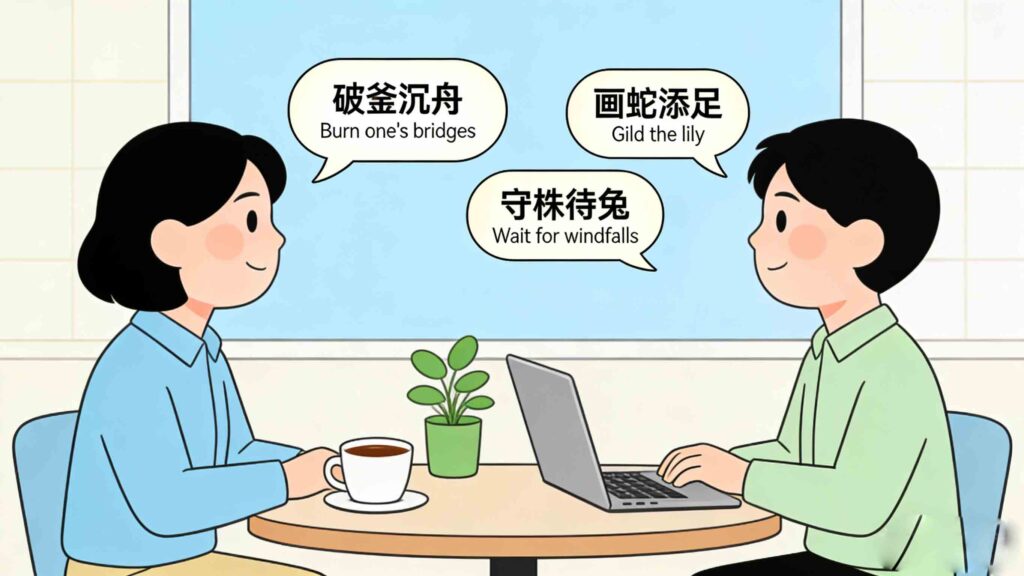
Why Learn Chinese Idioms to English for Daily Use?
Idioms are the “flavor” of language. Translating chinese idioms to english correctly helps you:
- Avoid awkward literal translations that confuse native speakers
- Sound more natural and confident in both languages
- Understand cultural references in movies, books, and conversations
15 Practical Chinese Idioms to English (Daily Use)
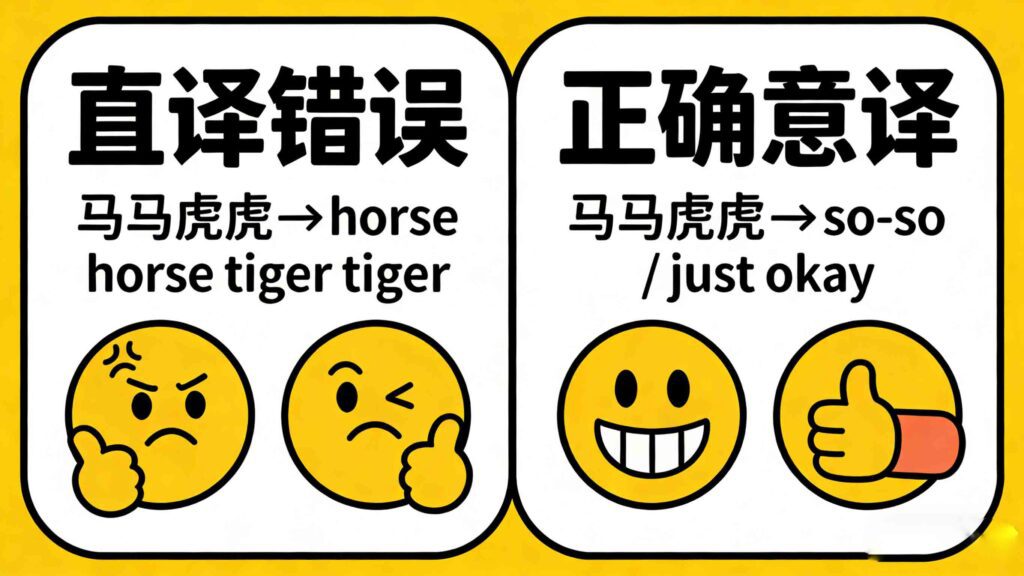
1、 马马虎虎 (Mǎ Mǎ Hǔ Hǔ)
Literal English
Horse horse tiger tiger
Natural English
So-so / Just okay / Not great
Example
A: “How was your presentation?”
B: “Mǎ mǎ hǔ hǔ—they liked the slides, but I forgot some key points.”
2、 半斤八两 (Bàn Jīn Bā Liǎng)
Literal English
Half a jin vs. eight taels (both equal 250g)
Natural English
Six of one, half a dozen of the other / As bad as each other
Example
“Both candidates are inexperienced—they’re bàn jīn bā liǎng.”
3、 画蛇添足 (Huà Shé Tiān Zú)
Literal English
Draw a snake and add feet
Natural English
Overdo it / Gild the lily / Add unnecessary details
Example
“The report was perfect until you added that extra chart—it’s huà shé tiān zú.”
4、 人山人海 (Rén Shān Rén Hǎi)
Literal English
People mountain, people sea
Natural English
Packed / Crowded / A sea of people
Example
“The subway during rush hour is rén shān rén hǎi—you can barely move.”
5、 开门见山 (Kāi Mén Jiàn Shān)
Literal English
Open the door and see the mountain
Natural English
Get straight to the point / Cut to the chase
Example
“Let’s kāi mén jiàn shān—we need to talk about the budget cuts.”
6、 对牛弹琴 (Duì Niú Tán Qín)
Literal English
Play the qín to a cow
Natural English
Talk to a brick wall / Waste your breath
Example
“I tried to explain the new policy to him, but it’s duì niú tán qín—he doesn’t care.”
7、 亡羊补牢 (Wáng Yáng Bǔ Láo)
Literal English
Fix the pen after the sheep are gone
Natural English
Better late than never / Fix a problem after it happens
Example
“We missed the deadline, but we can wáng yáng bǔ láo by submitting the report tomorrow.”
8、 一石二鸟 (Yī Shí Èr Niǎo)
Literal English
One stone, two birds
Natural English
Kill two birds with one stone
Example
“If we have the meeting at the café, we can yī shí èr niǎo—discuss the project and grab lunch.”
9、 三心二意 (Sān Xīn Èr Yì)
Literal English
Three hearts, two minds
Natural English
Indecisive / Half-hearted / Not committed
Example
“He’s sān xīn èr yì about the job offer—he can’t decide if he wants to move.”
10、 九牛一毛 (Jiǔ Niú Yī Máo)
Literal English
One hair from nine cows
Natural English
A drop in the bucket / Insignificant
Example
“The $500 donation is jiǔ niú yī máo compared to the $10,000 we need.”
11、 趁热打铁 (Chèn Rè Dǎ Tiě)
Literal English
Strike while the iron is hot
Natural English
Strike while the iron is hot / Act when the time is right
Example
“The client liked our proposal—let’s chèn rè dǎ tiě and sign the contract today.”
12、 抛砖引玉 (Pāo Zhuān Yǐn Yù)
Literal English
Throw a brick to attract jade
Natural English
Start with a rough idea to inspire better ones
Example
“This is just a draft—pāo zhuān yǐn yù, so please share your thoughts.”
13、 小题大做 (Xiǎo Tí Dà Zuò)
Literal English
Make a big deal out of a small problem
Natural English
Make a mountain out of a molehill / Overreact
Example
“She cried because her coffee was cold—total xiǎo tí dà zuò.”
14、 虎头蛇尾 (Hǔ Tóu Shé Wěi)
Literal English
Tiger head, snake tail
Natural English
Start strong, finish weak / Fizzle out
Example
“The project was hǔ tóu shé wěi—we had a great plan, but no one followed through.”
15、 一视同仁 (Yī Shì Tóng Rén)
Literal English
Treat everyone the same
Natural English
Treat everyone equally / No favoritism
Example
“A good manager should yī shì tóng rén—don’t play favorites with your team.”
A Three-Step Way to Translate Chinese Idioms
1. Keep the Literal Picture
Start by identifying what the Chinese characters picture. This prevents the translation from losing the memorable image. The literal version is a learning aid, not necessarily the phrase an English speaker would use in the same conversation.
2. Identify the Speaker’s Intention
Ask whether the speaker is praising, warning, criticizing, joking, or wishing someone well. The same literal image can support different English wording depending on that intention. A dictionary gloss gives a starting point, while the surrounding sentence decides the best equivalent.
3. Test the Natural English in Context
Replace the idiom with the proposed English equivalent and read the whole sentence. If the tone or relationship changes, choose a different wording. A natural translation should preserve the function of the original even when the words are not literal.
Common Beginner Mistakes
- Using a word-for-word translation as if it were a familiar English idiom.
- Choosing the first dictionary gloss without checking whether it fits the sentence.
- Ignoring whether the Chinese phrase is positive, negative, formal, or humorous.
- Assuming one English equivalent works in every context.
For additional source and usage notes, consult the Ministry of Education Dictionary of Chinese Idioms. It separates pronunciation, interpretation, source material, and examples, which makes it useful for checking a beginner translation.
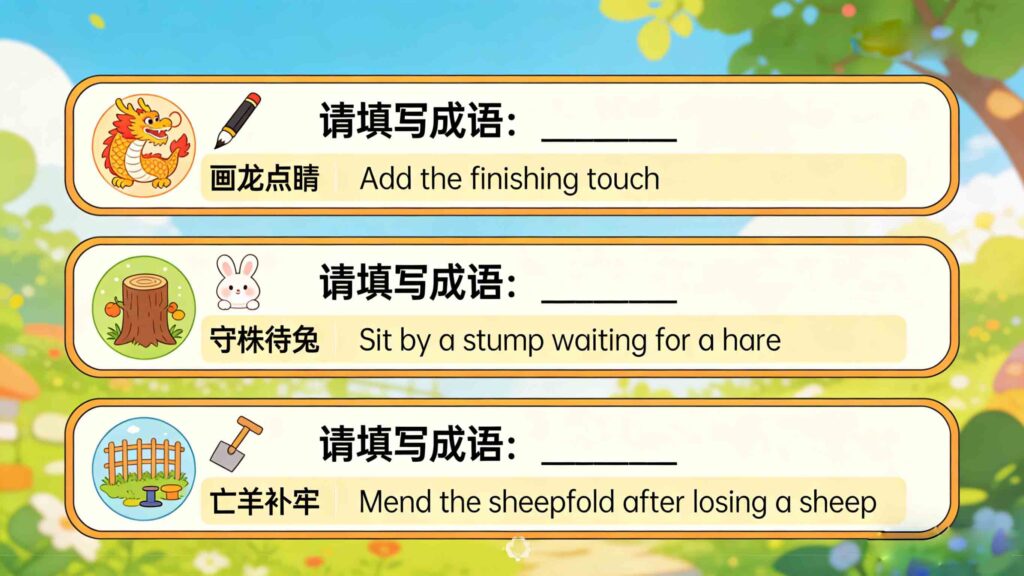
Fun Exercise: Use These Idioms in a Sentence
Practice your chinese idioms to english skills by filling in the blanks:
- “The party was ______ (人山人海)—we could barely find a place to stand.”
- “Don’t ______ (画蛇添足)—the design is already perfect.”
- “I need to ______ (开门见山)—we’re over budget and need to cut costs.”
Answer Key: 1. packed / a sea of people; 2. overdo it / gild the lily; 3. get straight to the point / cut to the chase
Continue with Focused Practice
Use the sentence practice guide to place these expressions in complete Chinese sentences, or review the 10 common idioms shortlist before adding more phrases.
Frequently Asked Questions About Chinese Idiom Translation
Why is the literal translation different from natural English?
The literal version preserves the Chinese image, while natural English expresses the intended meaning in context.
Can children memorize only the English equivalent?
They should also learn the Chinese example and situation so they do not use the idiom in the wrong context.
How many translations are included here?
This page contains 15 Chinese idioms with literal and natural English explanations.