Quick answer: Five useful Chinese idioms about happiness express different kinds of joy. Use 心花怒放 for inward delight, 喜出望外 for an unexpectedly good result, 眉开眼笑 for a visibly happy expression, 欢天喜地 for exuberant celebration, and 其乐融融 for warm happiness shared by a group.
They overlap, but they are not interchangeable in every sentence. First identify what caused the happiness, whether it is visible on one person’s face, and whether the scene belongs to an individual or a group.
- Learning task
- Match each phrase to the source of the joy, the visible behavior, and the number of people involved.
- Written form
- Simplified characters in headings; traditional forms are listed in each fact card.
- Pronunciation
- Mandarin pinyin with tone marks.
- Evidence boundary
- Definitions and source notes follow Ministry of Education dictionary entries. English examples and family activities are new teaching material.
Compare the five happiness idioms before memorizing them
A translation such as “very happy” is useful only as a starting point. One phrase may describe a feeling inside the heart, another the surprise that caused it, another a smile that other people can see, and another the atmosphere of a whole family gathering. This distinction is the practical answer to the question behind the keyword.
| Idiom | Pinyin | Best clue | Natural situation |
|---|---|---|---|
| 心花怒放 | xīn huā nù fàng | Inner delight blooms | A learner receives praise for work they cared about. |
| 喜出望外 | xǐ chū wàng wài | Good result was unexpected | A missing book is returned after the owner had given up hope. |
| 眉开眼笑 | méi kāi yǎn xiào | Joy is visible on the face | A grandparent beams when the family arrives. |
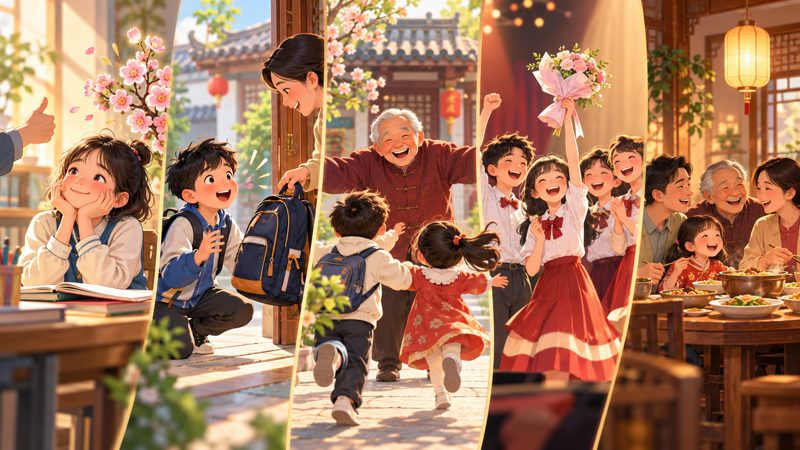
| 欢天喜地 | huān tiān xǐ dì | Open, energetic celebration | Students celebrate the end of a successful performance. |
| 其乐融融 | qí lè róng róng | Warm joy shared by a group | Several generations talk and eat together comfortably. |
心花怒放: happiness felt as something blooming inside
- Read it
- xīn huā nù fàng · traditional form is the same.
- Literal image
- The flower of the heart bursts into bloom.
- Use it for
- Strong inward delight that becomes difficult to hide.
The metaphor makes an internal feeling vivid. The Ministry of Education entry for 心花怒放 explains the phrase as a flower-like image for an extremely happy and open state of mind. It works when the emotional center matters more than the event itself.
Example: 听到老师肯定她的作品,她心花怒放。 After hearing the teacher praise her work, she was filled with delight.
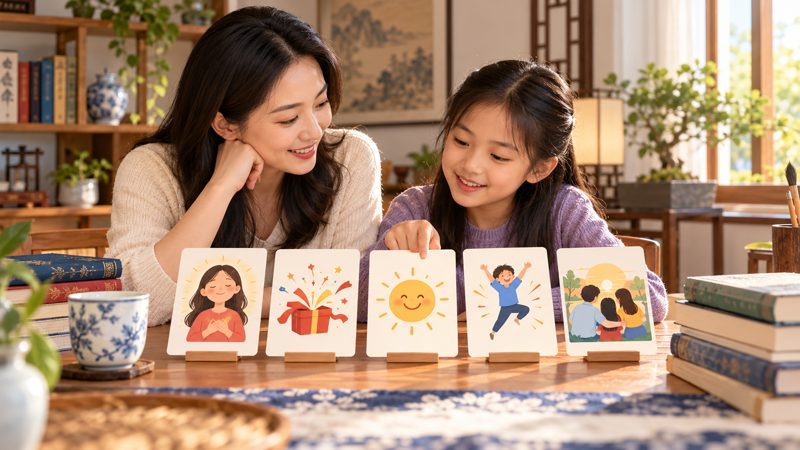
Meaning check: Ask a child to draw a closed bud and an open flower. Which one matches a person who has just received meaningful praise? The drawing explains the metaphor without treating the English gloss as a word-for-word translation.
喜出望外: joy because the result exceeded expectation
- Read it
- xǐ chū wàng wài · traditional form is the same.
- Key clue
- 望外 means beyond what was expected.
- Use it for
- A welcome result that arrives unexpectedly or turns out better than expected.
The cause matters here. The dictionary entry for 喜出望外 links the expression to joy arising from something outside one’s expectation and cites a letter by the Song writer Su Shi. Do not use it for a planned celebration whose good result everyone already expected.
Example: 她以为书包找不回来了,没想到同学送了回来,真是喜出望外。 She thought the schoolbag was gone, so its unexpected return delighted her.
眉开眼笑: happiness that can be seen on the face
- Read it
- méi kāi yǎn xiào · traditional: 眉開眼笑.
- Literal image
- The brows open and the eyes smile.
- Use it for
- A pleased facial expression that other people can observe.
The MOE entry for 眉开眼笑 focuses on an expression of delight: relaxed brows and smiling eyes. This makes it useful when a narrator can see happiness on someone’s face. It does not explain whether the news was expected.
Example: 爷爷看到孩子们进门,马上眉开眼笑。 Grandpa beamed as soon as the children came through the door.
欢天喜地: happiness expressed as lively celebration
- Read it
- huān tiān xǐ dì · traditional: 歡天喜地.
- Literal image
- Joy in heaven and happiness on earth.
- Use it for
- Very happy, energetic behavior or a strongly celebratory atmosphere.
The dictionary entry for 欢天喜地 defines an intensely happy state and records the phrase in early vernacular fiction. In modern use, it often fits a crowd, a family, or one person behaving with open excitement.
Example: 演出顺利结束,孩子们欢天喜地地跑去找父母。 After the performance ended successfully, the children ran happily to find their parents.
其乐融融: warm happiness shared together
- Read it
- qí lè róng róng · traditional: 其樂融融.
- Key clue
- 融融 suggests warmth and harmony.
- Use it for
- A group enjoying a comfortable, harmonious time together.
The MOE reference for 其乐融融 traces the wording to the Zuo Zhuan and gives the familiar family-gathering sense. Unlike 眉开眼笑, this phrase normally describes a scene or group atmosphere rather than one person’s facial expression.
Example: 一家人边吃饭边聊天,其乐融融。 The family ate and talked together in warm harmony.
Comparison: use three clues to match the phrase
- Was the good result unexpected? If yes, 喜出望外 is the most precise of these five.
- Are you describing one person’s feeling or visible face? Choose 心花怒放 for inward delight and 眉开眼笑 for the expression.
- Are several people sharing the moment? 欢天喜地 stresses energetic celebration; 其乐融融 stresses warm harmony.
A learner who can explain this choice understands more than someone who memorizes five English glosses. The same comparison method also works with Chinese idioms about friendship and Chinese idioms about success.
Try a ten-minute family sorting activity
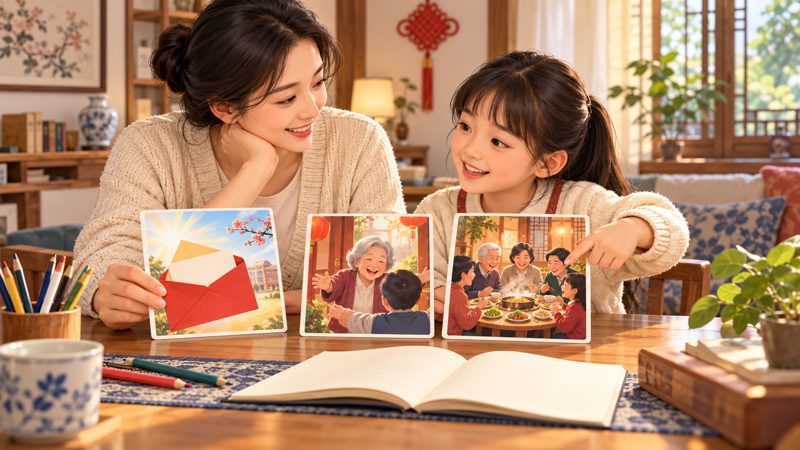
Write three situations on separate cards: an unexpected acceptance letter, a grandparent smiling at a child, and a relaxed family meal. Read the five idioms aloud, then ask the learner to place the best phrase beside each situation and explain the clue. More than one phrase may be possible, but the explanation must account for surprise, expression, energy, or group harmony.
Next, change one detail. Make the letter expected, turn the quiet meal into a loud victory party, or describe only the grandparent’s inward feeling. The learner should decide whether the idiom changes and why. For younger learners, the story-and-picture routine in our Chinese idioms for kids guide offers a simple retelling structure.
Questions about Chinese idioms about happiness
What is the most general Chinese idiom for feeling very happy?
Among these five, 心花怒放 is a flexible choice for strong inward delight. It still carries a vivid blooming metaphor, so plain words such as 高兴 may be more natural when no idiom is needed.
Which idiom describes happiness caused by unexpected news?
喜出望外 is the precise choice because the good result falls outside the person’s expectation. The surprise is part of the meaning, not merely extra context.
What is the difference between 眉开眼笑 and 欢天喜地?
眉开眼笑 focuses on a pleased facial expression. 欢天喜地 describes very lively happiness or celebration and can cover a broader scene.
Can 其乐融融 describe one person?
It is normally better for a group or shared atmosphere, especially family members enjoying time together. For one person’s visible joy, 眉开眼笑 is usually more direct.
How can a parent teach happiness idioms without making children memorize a list?
Use one picture or short situation per phrase. Ask what caused the joy, what can be seen, and whether the happiness belongs to one person or a group. Then change one clue and let the child choose again.
Source and learning anchor
- 心花怒放: inward delight expressed through the flower-of-the-heart metaphor.
- 喜出望外: joy caused by an unexpected favorable result.
- 眉开眼笑: happiness visible in a smiling facial expression.
- 欢天喜地: intense, openly expressed happiness.
- 其乐融融: warm, harmonious happiness shared in a group.
The source notes above support definitions and usage boundaries. The English translations are teaching glosses, not claims of exact equivalence, and the new examples are original rather than historical quotations.