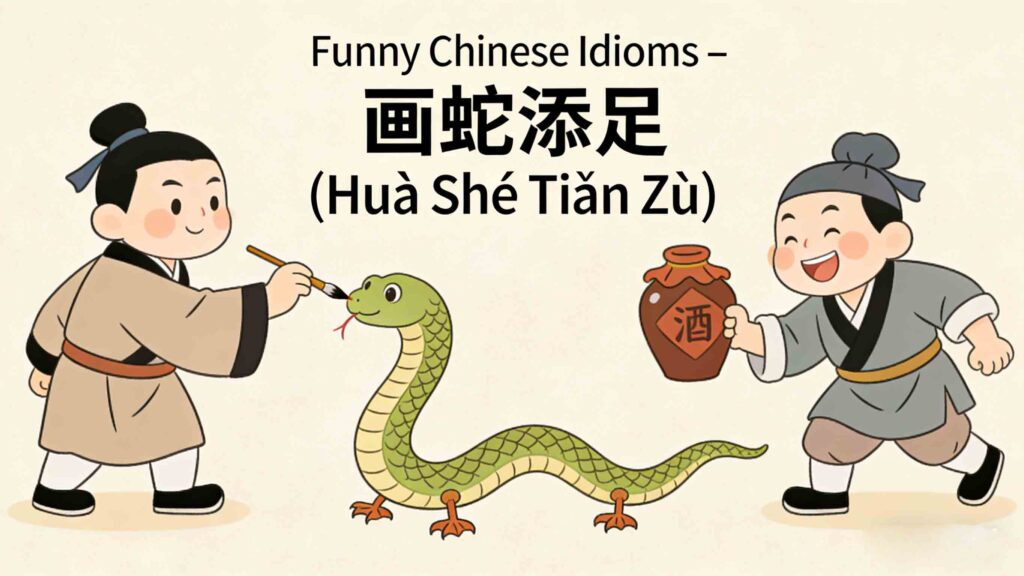
Hua She Tian Zu means “drawing a snake and adding feet”: doing something unnecessary that ruins an otherwise good result. This page explains the story, English meaning, and modern usage of this funny Chinese idiom.
Quick Answer: What Does Hua She Tian Zu Mean?
Hua She Tian Zu means “draw a snake and add feet.” The idiom describes ruining something that was already good by adding unnecessary extra work. English readers may also see it as “add legs to a snake,” but “add feet” is the closer literal phrasing.
Basic Facts for This Search
| Idiom | 画蛇添足 / Hua She Tian Zu |
| Literal image | Drawing a snake, then adding feet to it |
| Core meaning | Spoiling a completed task by doing too much |
| Common English wording | Draw a snake and add feet, or add legs to a snake |
Feet or Legs: Which English Translation Should You Use?
Searchers use both “draw snake add feet” and “draw snake add legs.” For a simple learner explanation, “feet” is the better literal translation because 足 points to feet. “Legs” is also understandable in English because the image is an animal body with unnecessary limbs, but it is less exact.
The useful lesson is the same in either wording. Hua She Tian Zu warns against adding a clever-looking extra detail after the main work is already finished. In writing, design, teaching, and daily decisions, the idiom fits moments when more effort makes the result worse instead of better.
For more context, compare this idiom with related story pages such as Chinese four-character idioms, Chinese idiom stories collection, Chinese chengyu stories.
How to use this page
Use this page first as a meaning check, then as a usage check. Hua She Tian Zu is useful when the reader needs to understand the pinyin, the literal snake-and-feet picture, and the modern warning against overdoing a finished task.
In a search result, Hua She Tian Zu should answer three questions quickly: what the idiom means, why “draw a snake and add feet” is the literal image, and when a speaker would use the phrase. Hua She Tian Zu is not only a funny story; Hua She Tian Zu is also a practical warning about unnecessary additions. If a learner remembers Hua She Tian Zu as “too much extra work can spoil the result,” the main meaning is clear.
For English wording, Hua She Tian Zu can be explained as “draw a snake and add feet.” Some readers type “draw snake add legs,” so this page also clarifies that Hua She Tian Zu is closer to feet in literal wording while legs remains a common search phrasing.
Frequently Asked Questions
What is the simple meaning of Hua She Tian Zu?
It means ruining a finished or adequate result by adding something unnecessary.
Is “draw a snake and add legs” wrong?
It is understandable, but “draw a snake and add feet” is closer to the literal Chinese wording.
When can I use this idiom?
Use it when someone overdoes a task, adds needless details, or makes a simple result worse by trying to improve it too much.
Introduction
Chinese idioms (chéngyǔ, 成语) are not just linguistic relics. They’re packed with humor, wisdom, and vivid storytelling. For anyone learning Chinese, exploring Chinese idioms funny meanings is a delightful choice. It deepens cultural understanding and makes conversations more lively. Today, we’re diving into one of the most iconic and amusing idioms: Huà Shé Tiān Zú (画蛇添足).
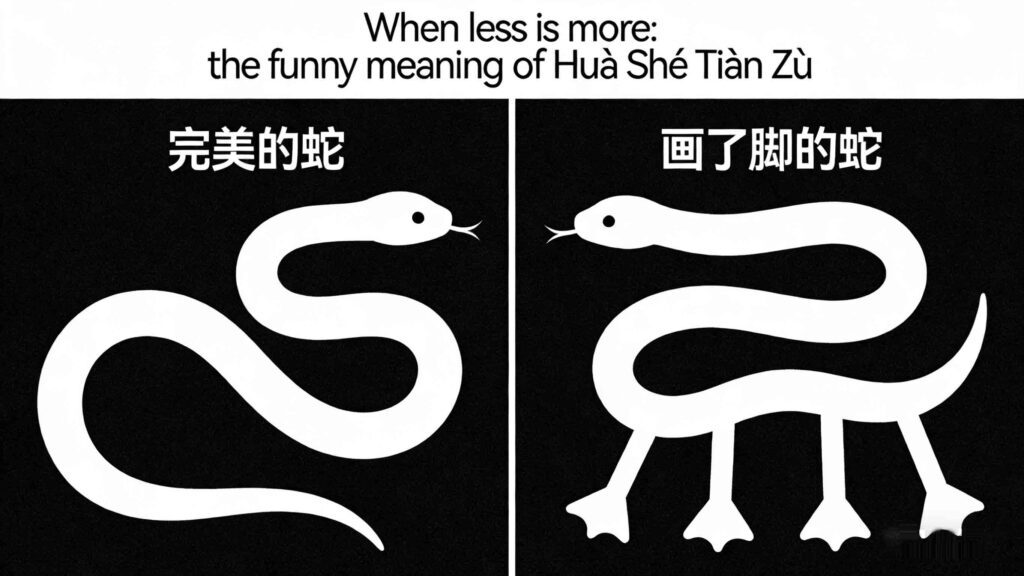
This phrase literally translates to “drawing a snake and adding feet.” Its funny meaning translates perfectly to English: doing something unnecessary and extra. This ultimately ruins an otherwise good situation. It’s the perfect way to call out overdoing it, and its origin story is as entertaining as its modern usage.
The Origin Story: Where “Huà Shé Tiān Zú” Came From
The idiom traces back to the Warring States period (475–221 BCE) in ancient China. Here’s the classic tale:
A group of servants were given a pot of wine by their master. Since there wasn’t enough for everyone, they decided to hold a drawing contest: the first person to draw a snake on the ground would get to drink the wine.
One servant finished his snake quickly and, seeing the others still busy, decided to show off. “I can even add feet to it!” he boasted. As he was drawing the legs, another servant finished his snake and snatched the wine pot. “Snakes don’t have feet!” he said. “By adding them, you’ve ruined the drawing—and lost the wine!”
This funny story gave birth to the idiom, which now means “to overdo something unnecessary and spoil the result.”
Funny Meaning & Modern Usage
In modern Chinese, Huà Shé Tiān Zú is used to describe situations where someone goes too far, adding extra details or actions that are not only unnecessary but also harmful to the final outcome. It’s a lighthearted way to point out overkill, and its funny meaning makes it relatable across cultures.
In English, you can think of it as:
·“Gilding the lily”
·“Overdoing it”
·“Putting the cart before the horse” (in some contexts)
Example Sentences
Here are a few ways to use this idiom in daily conversation:
1、“Your presentation was great, but adding that extra slide about your cat was just Huà Shé Tiān Zú—it distracted everyone from your main point.”
2、“The cake was perfect until you added that neon pink frosting. Talk about Huà Shé Tiān Zú!”
3、“Don’t be Huà Shé Tiān Zú with your resume—keep it concise and focus on your key achievements.”

Why This Idiom Matters for Language Learners
Exploring Chinese idioms funny meanings like this one isn’t just about memorizing phrases—it’s about understanding the cultural context and humor that make Chinese so rich.
When you use Huà Shé Tiān Zú correctly, you’re not just speaking Chinese. You’re connecting with native speakers on a deeper level. You show that you “get” the jokes and wisdom behind the language.
Plus, idioms like this make your speech and writing more colorful and memorable. Instead of saying “you overdid it,” you can say “you drew feet on a snake”—and that’s way more fun!
Final Thoughts
Huà Shé Tiān Zú is more than just a funny Chinese idiom—it’s a lesson in restraint and knowing when to stop. Whether you’re learning Chinese for travel, work, or fun, understanding Chinese idioms funny meanings will make your journey more enjoyable and your communication more authentic.
Next time you see someone overdoing it, remember the snake with feet—and maybe even use this idiom to lighten the mood!
For a deeper dive into the cultural and linguistic background of this idiom, you can refer to the authoritative entry on Huà Shé Tiān Zú (画蛇添足) on Wikipedia. This resource provides a detailed account of the idiom’s origin, evolution, and usage across different contexts.
If you want to explore more Chinese idioms funny meanings, check out our previous guide on 守株待兔 (Shǒu Zhū Dài Tù): The Funny Meaning of Waiting for a Rabbit to learn another classic and humorous phrase.