Quick answer: Three useful Chinese idioms about wisdom describe different thinking tasks: 三思而行 means thinking carefully before acting; 见微知著 means recognizing a larger development from small signs; 集思广益 means gathering people’s useful ideas. They are not interchangeable ways to say that someone is clever.
For learners, the practical question is what the person actually does. Do they consider a choice, interpret evidence, or invite other viewpoints? Matching the phrase to that action produces a clearer sentence than translating every expression as “wisdom.” These three offer a manageable starting set, rather than an exhaustive or ranked list.
- Character forms
- Headings use simplified Chinese; traditional forms appear below.
- Pronunciation
- Mandarin pinyin with tone marks.
- Source basis
- Meanings and source notes follow the Ministry of Education dictionary entries linked beside each expression.
- Learning examples
- The modern sentences and activities are original teaching material, not quotations from classical texts.
Compare three thinking tasks before choosing a phrase
Each expression highlights a process. 三思而行 concerns the care taken before an action. 见微知著 concerns the connection between an observable clue and a larger development. 集思广益 concerns collecting and considering contributions from other people. None of these requires the person to know everything or guarantees a correct result.
| Idiom and pinyin | Core task | A fitting situation |
|---|---|---|
| 三思而行 sān sī ér xíng |
Consider carefully before acting | A learner checks the consequences before sending an angry message. |
| 见微知著 jiàn wéi zhī zhù |
Understand a larger development through small signs | Several small failures help a team recognize a growing problem. |
| 集思广益 jí sī guǎng yì |
Draw on useful contributions from several people | A class compares different suggestions before planning an event. |

三思而行: think carefully, then act
- Read it
- sān sī ér xíng · traditional form: 三思而行.
- Literal wording
- Think three times, then act.
- Modern meaning
- Consider a matter carefully before taking action.
The MOE entry for 三思而行 traces the expression to the Analects, “Gongye Chang.” Its account discusses Ji Wenzi’s repeated consideration before action and Confucius’s response that considering twice would suffice. The modern idiom encourages caution; the source context also leaves room to question excessive hesitation.
Example: 这条消息可能让朋友误会,发送之前要三思而行。 This message could cause a misunderstanding, so think carefully before sending it. Here the pause has a purpose: consider how the words might be received and whether a clearer message is possible.
“Think exactly three times” is too literal as a general usage rule. Conversely, merely waiting for a long time does not demonstrate thoughtful consideration. If a student keeps postponing a choice without examining it, a description of hesitation may be more accurate. Use the idiom when the care taken before acting is the point of the sentence.
见微知著: connect small signs with a larger development
- Read it
- jiàn wéi zhī zhù · traditional form: 見微知著.
- Literal contrast
- 微 refers to small or subtle signs; 著 to what becomes evident.
- Modern meaning
- Recognize a larger development from its small indications.
The MOE reference for 見微知著 explains the relation between subtle signs and an evident trend. It cites Yue Jue Shu, attributed to Yuan Kang. This source note supports a meaning and textual attribution; it does not establish a particular modern teaching story as a historical event.
Example: 她从几次交接中的小失误看出流程有问题,真能见微知著。 She recognized a problem in the process from several small handover mistakes. The sentence connects limited observations to a wider pattern. It says more than “she noticed something small.”
In a learning exercise, ask for both parts: “What did you observe?” and “What larger issue might it suggest?” A drooping leaf, for example, is a reason to inspect a plant further; it does not by itself prove the cause. That distinction helps learners understand inference without turning the idiom into permission to guess confidently.
Usage limit: Do not use the phrase as evidence that a conclusion is true. Whether an inference is well supported still depends on the observations and explanation. The idiom names a way of recognizing developments, not a method of predicting events with certainty.
集思广益: gather useful ideas from other people
- Read it
- jí sī guǎng yì · traditional form: 集思廣益.
- Literal components
- Gather thinking and broaden the benefit.
- Modern meaning
- Bring together people’s wisdom and absorb useful suggestions.
The MOE entry for 集思廣益 connects it with the Dong He biography in the Records of the Three Kingdoms. The source explanation describes Zhuge Liang valuing discussion and useful disagreement among those advising him. The emphasis is on contributions that improve deliberation.
Example: 设计班级活动时,大家集思广益,提出了几种不同的方案。 When planning the class activity, everyone contributed ideas and proposed several different plans. The expression fits because different people supply thoughts that can be considered together.
A meeting does not automatically demonstrate 集思广益. If one person announces a fixed answer and ignores everyone else’s suggestions, simply having a group in the room misses the expression’s main idea. Nor does the phrase require every suggestion to be accepted. Comparing suggestions, asking questions and choosing useful parts can all serve the shared task.

Which expression fits the situation?
Try describing the same school project in three different sentences. Before starting, a student considers the time, materials and likely difficulties: 三思而行. During a trial, several small faults reveal a weakness in the plan: 见微知著. To improve it, classmates compare their suggestions: 集思广益. All three may belong to one project, but each points to a different part.
- Choose 三思而行 when the sentence centers on a consequential choice and careful consideration before acting.
- Choose 见微知著 when small observations support understanding of something larger.
- Choose 集思广益 when useful ideas from several people contribute to the thinking.
If the situation contains none of those actions, use a simpler description. A person who solves a puzzle quickly may be 聪明, “clever,” without demonstrating any one of these three processes. A reader interested in textual context can also explore our guide to Chinese idioms from history.
Try the distinction at a family table
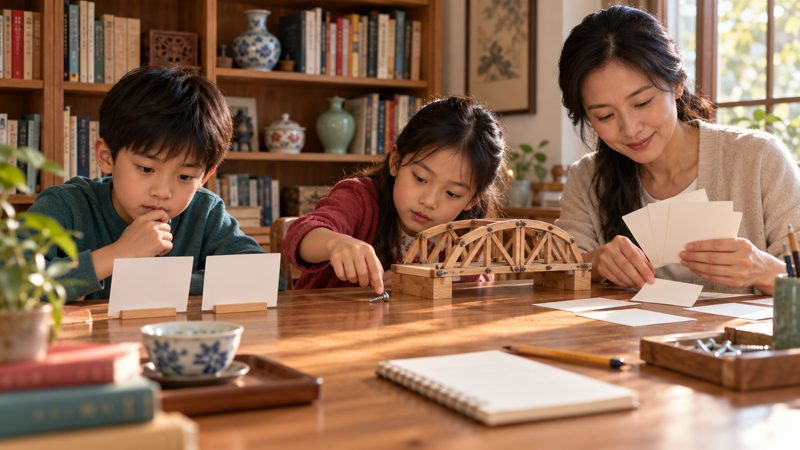
Use a small craft project, such as planning a paper bridge. Before building, ask the learner to consider two designs and explain a choice. Then inspect a trial model for clues that it may need a change. Finally, invite each person to suggest one improvement and compare the proposals. Name the idiom only after the learner describes the action.
Change one detail to test understanding. Would merely delaying the project show 三思而行? Would noticing a mark without drawing a larger conclusion show 见微知著? Would silently accepting one person’s plan show 集思广益? Ask the learner to explain what is missing. Our Chinese idioms for kids guide offers additional story-based practice.
Questions about wisdom idioms
Does 三思而行 mean thinking exactly three times?
Its literal wording mentions three, but its modern meaning is to consider carefully before acting. It is not a universal counting instruction.
Is 见微知著 the same as predicting the future?
No. It concerns understanding a larger development from small signs. It does not guarantee a prediction or make unsupported guesses reliable.
Can 集思广益 describe one person thinking alone?
Not normally. Its central idea is drawing together people’s wisdom and useful opinions. One person can organize that process, but solitary reflection alone misses the collective element.
Are these idioms suitable as a general compliment?
They work best when a specific action supports the description. Use a plain compliment for general intelligence, and reserve each idiom for the kind of thinking it describes.
Source and usage anchor
The official entries linked above provide the readings, meanings and textual notes for 三思而行, 見微知著 and 集思廣益. English glosses help explain usage; they are not exact equivalents. The new examples and learning scenes illustrate the distinctions rather than document ancient events.