These 3 quick, fun chinese idiom games for kids are the perfect way to bond with your child while teaching easy chengyu—no fancy materials needed, just playful learning and quality time.
Quick Answer
The best Chinese idiom games for kids connect four things: the characters, pronunciation, meaning, and a situation the child can recognize. The three activities below use acting, matching, and rhythm. Each can be played in about 10 to 20 minutes with a small set of familiar idioms.
Basic Facts
| Game | Main skill | Best starting age |
|---|---|---|
| Charades | Meaning and recall | 6+ |
| Matching cards | Characters and visual association | 5+ |
| Rhythm and repeat | Pronunciation and memory | 4+ |
Quick reference: begin with three to five idioms, explain each meaning before scoring, and end by asking the child to use one phrase in a new situation.
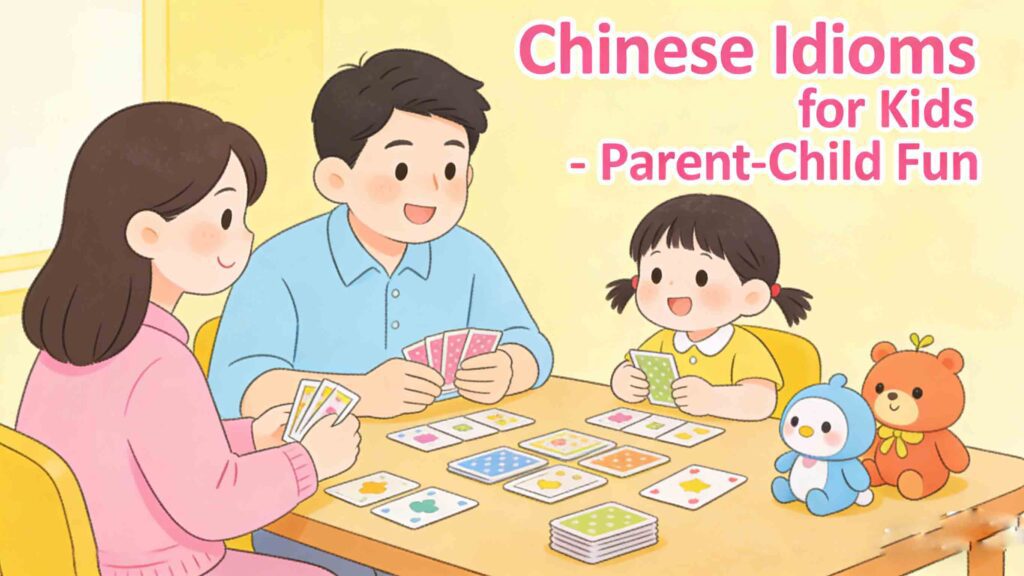
Why Game-Style Learning Works for Chinese Idiom Games for Kids
Kids learn best when they’re having fun, and these activities keep them engaged while building real language skills:
- Playful repetition helps kids remember idioms long-term
- Parent-child interaction strengthens your bond
- Kids learn to use idioms in context, not just memorize them
- It introduces Chinese culture in a kid-friendly way
Choose Idioms That Can Be Shown or Explained
For a first session, avoid expressions whose meaning depends on a long historical explanation. Pick actions, emotions, or results that a child can represent with a gesture or picture. Before play begins, read each card together, say the pinyin once, and give one plain-language example.
A game round is not complete when the child only guesses the characters. Ask one follow-up question: “What kind of situation would this describe?” If the answer is unclear, offer two situations and let the child choose. This keeps the activity focused on usage rather than visual guessing alone.
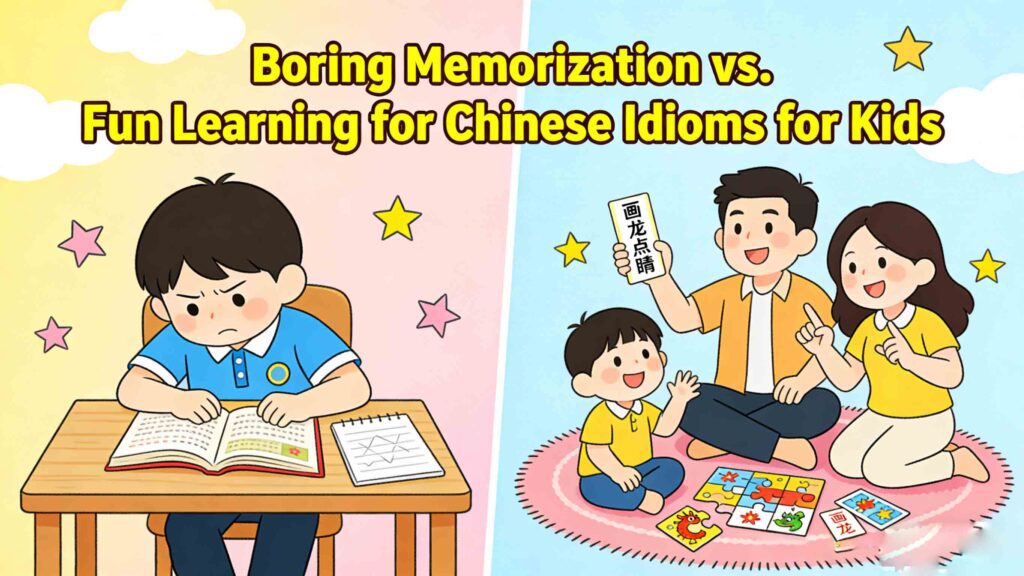
3 Quick & Fun Chinese Idiom Games for Kids
Game 1: Idiom Charades (Chinese Idiom Games for Kids Edition)
Charades is perfect for teaching chinese idioms for kids—it uses body language to make meanings stick.
What You Need
- 5 simple idiom cards (e.g., 鸡飞蛋打,手舞足蹈,目瞪口呆)
- A timer (optional)
How to Play
- Take turns picking a card and acting out the idiom (no talking!).
- If your partner guesses correctly, celebrate with a high-five!
- After each round, explain the idiom’s meaning in simple terms.
Game 2: Idiom Matching Cards (Learn Chinese Idioms for Kids Visually)
Visual learning is key for kids, so this game connects idioms to pictures for easy understanding.
What You Need
- 10 cards: 5 with idioms (pinyin + characters) and 5 with simple drawings
How to Play
- Lay all cards face down.
- Take turns flipping two cards to find a match (e.g., 鸡飞蛋打 + drawing of a chicken and broken eggs).
- The player with the most pairs wins!
- After each match, say the idiom together and explain its meaning.
Game 3: Idiom Rhyme & Repeat (Practice Chinese Idioms for Kids)
This game makes practicing pronunciation fun with rhymes and rhythm, helping kids remember idioms easily.
What You Need
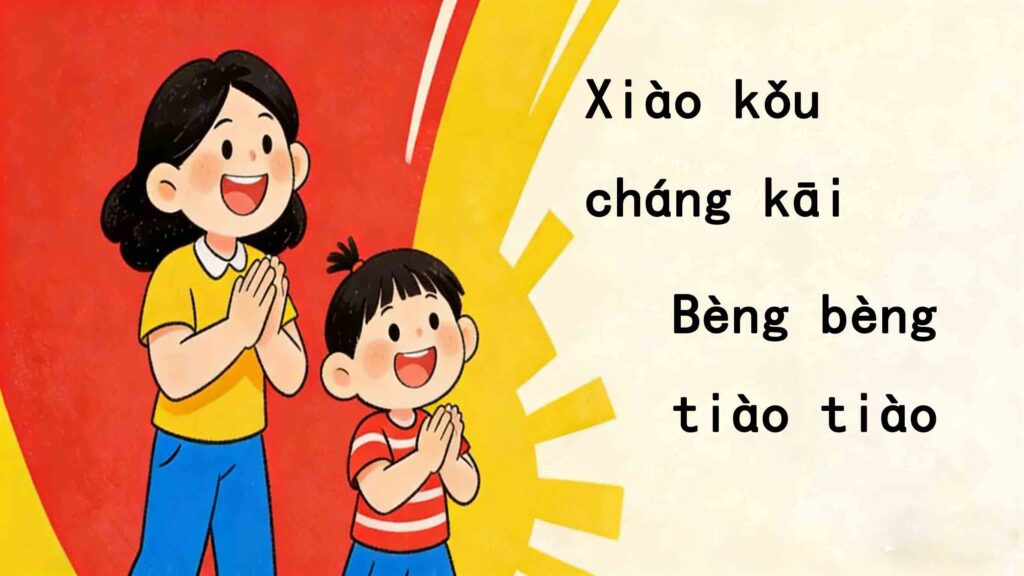
- 5 simple idioms with easy pronunciation (e.g., 蹦蹦跳跳,笑口常开)
How to Play
- Say the idiom slowly, breaking it into syllables (e.g., “Bèng – Bèng – Tiào – Tiào”).
- Your child repeats it back—praise their effort!
- Make up a silly rhyme together (e.g., “Bèng bèng tiào tiào, the rabbit goes hop hop!”).
- Clap to the rhythm as you repeat the rhyme—kids love the musicality!
Make Each Game Easier or Harder
For younger children: show the picture side of a card first, keep the round cooperative, and let the child repeat the phrase after an adult. One correct meaning match is enough; handwriting and origin stories can wait.
For readers: separate the character card, pinyin card, meaning card, and picture. The child must build a four-part set. Ask for one short sentence after each completed match.
For siblings or a class: use teams, but award separate points for a correct guess, a clear meaning, and an appropriate example. This prevents the fastest actor from deciding every round and gives quieter learners another way to contribute.
A 15-Minute Parent-Child Session
- Minutes 1-3: preview three idioms and explain unfamiliar characters.
- Minutes 4-9: play one main game for two short rounds.
- Minutes 10-12: switch roles so the child explains or leads.
- Minutes 13-15: choose one idiom and create a sentence about school, family, or a familiar story.
Stop while the child is still engaged. Reusing three idioms on several days is usually more useful than presenting a large new stack every session. Keep a small “mastered,” “needs another example,” and “new” pile so the next activity begins with evidence rather than guesswork.
Check Whether the Child Learned the Idiom
Recognition is only the first level. A child may match a picture while still misunderstanding the tone or the kind of person the idiom can describe. Use three quick checks: ask for the meaning without the picture, ask the child to choose between a fitting and non-fitting situation, and ask for a new sentence.
If the child cannot produce a sentence, simplify the prompt instead of marking the round wrong. Give a sentence frame such as “When ___ happened, it was really ___.” The goal is to connect the phrase to context gradually, not to turn a family game into a vocabulary test.
Prepare a Small, Reusable Game Set
Use index cards and keep the design simple. One card can show characters and pinyin; a partner card can show a situation rather than a literal word-for-word drawing. On the back, write a plain explanation and one sentence that clearly fits.
Choose a balanced set: an action that is easy to act, an emotion that can be recognized, and a result or judgment that requires discussion. This prevents the activity from becoming only a mime contest.
Rotate Instead of Replacing Everything
Keep two familiar idioms and add one new idiom in the next session. After several sessions, move phrases the child can explain and use into a review envelope, then bring them back a week later.
Invite the child to design one card. Choosing a picture, character clue, and example requires deeper processing than selecting an answer and often reveals misunderstandings early.
Keep Scores Useful, Not Distracting
A simple score can motivate a group, but do not award every point for speed. Give one point for identifying the phrase, one for explaining the meaning, and one for choosing a fitting situation. A child who needs more time can still demonstrate stronger understanding than the quickest guesser.
For cooperative play, set a shared target such as “explain five idioms correctly before the timer ends.” Let the child ask for one clue without losing the round. Useful clues include the emotional tone, the kind of action, or the first part of a sentence; avoid giving the English answer immediately.
End with a Transfer Question
Finish each game by asking where the idiom could appear outside the activity. It might describe a classroom mistake, a character in a story, a family plan, or a sports result. This final question turns a memorable game moment into language the child can recognize later.
Write down one successful example and one phrase that needs a clearer explanation. Those two notes are enough to plan the next session and are more informative than a total score alone.
Use the Child Explanation as the Main Signal
After a correct match, ask the child to explain the phrase to someone who did not play. A clear explanation should mention the situation and judgment, not only repeat the literal picture. If the explanation is incomplete, revisit one example instead of adding more cards.
Keep the tone supportive. The activity should make children curious about how compact expressions carry stories and judgments. A small set understood well is a stronger result than a large pile completed quickly.
Frequently Asked Questions About Chinese Idiom Games
How many idioms should one game use?
Three to five is enough for a first session. Add more only after the child can explain the earlier phrases in context.
Do children need to know the full origin story?
No. Start with meaning and usage. Add a short origin story when it helps memory or explains why the literal image differs from the modern meaning.
Should parents correct every tone immediately?
Model the correct pronunciation and repeat it naturally. During a fast game, prioritize comprehension; use the review stage for focused pronunciation practice.
Get More Chinese Idiom Games for Kids Resources
Love these games? Explore our collection of kid-friendly chengyu activities for more fun ways to learn together, including printable game ideas and simple idiom lists
For more in-depth, step-by-step activities and printable resources, visit our Premium Chengyu Learning Hub.
If you’d like to start with free materials, check out our Free Chinese Idioms for Kids Activity Pack, which includes printable flashcards and a beginner’s checklist.
For a deeper dive into the history and cultural background of Chinese idioms, you can explore the authoritative entry on Chengyu (Chinese Idioms) on Wikipedia.