Chinese idioms with stories and pictures are most useful when you connect three things: the action in the scene, the mistake or change in the story, and a present-day situation with the same pattern. The picture can anchor the memory, but the idiom’s meaning goes beyond the objects it shows.
Below are three short retellings with new interpretive illustrations. Read the scene first, then check the meaning and try the original modern example. The source notes identify the traditional texts recorded by the Ministry of Education’s idiom dictionary; these tales are not presented as verified historical events.
- Written forms
- 画蛇添足 · 守株待兔 · 掩耳盗铃; main text uses simplified characters.
- Pronunciation
- Mandarin pinyin with tone marks beside each expression.
- Cultural source
- Three attributed tales, checked against MOE dictionary entries.
- Modern use
- Needless additions, unrealistic expectations and self-deception.
Read the picture as part of a story
Begin with what you can actually point to: a drawing, a farming tool or a bell. Then ask what the person is doing with it. Naming the objects gives you a literal scene; explaining the choice and its consequence gets you closer to the idiom.
Keep those two answers separate. “A farmer is sitting by a stump” describes a picture, but it does not explain why someone might criticize a modern plan as 守株待兔. For that, you need the missing part of the tale: a lucky accident has been mistaken for a dependable way to get results.
The questions beside the illustrations are reading prompts you can use at home or in a lesson. They are suggestions rather than a tested teaching programme, and you can answer them in English before trying a Chinese sentence.
画蛇添足: the extra feet change the outcome
- Read it
- huà shé tiān zú · traditional: 畫蛇添足
- Literal image
- Draw a snake and add feet.
- Meaning here
- Make an unnecessary addition that spoils something already sufficient.
In the tale, a group holds a snake-drawing contest for a wine prize. The first person to finish has time left and starts adding feet to his snake. Another contestant finishes a proper snake and takes the prize. The extra work has cost the early finisher his advantage.
The MOE entry for 畫蛇添足 traces the tale to Zhan Guo Ce, “Qi Ce II.” Its point is the needless addition, not a rule that improving a draft is always wrong.
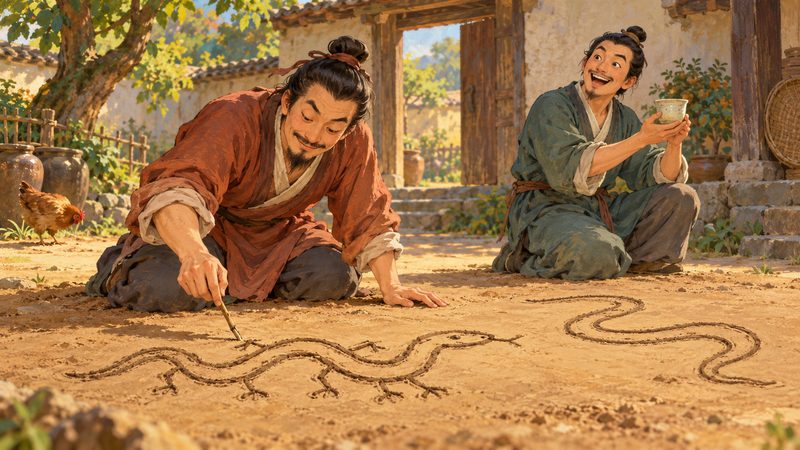
Picture question: If you covered the extra legs with your hand, which part of the mistake would disappear? The drawing itself is not the whole lesson; the addition changes the result.
Original modern example: A class poster already gives the correct meeting place and time. Adding several unnecessary paragraphs makes those details hard to find. A classmate could say, “这些多余的说明有点画蛇添足。” The criticism concerns the unhelpful addition, not the effort spent making the poster.
守株待兔: notice the work left undone
- Read it
- shǒu zhū dài tù
- Literal image
- Wait by a stump for a rabbit.
- Meaning here
- Expect good luck to repeat while neglecting useful action.
A farmer unexpectedly gets a rabbit after it runs into a tree and dies. He then stops farming and waits beside the tree for another lucky catch. It does not arrive. What worked once by accident has become his whole plan.
The MOE entry for 守株待兔 identifies Han Feizi, “Wu Du,” as the source. It records inflexible reliance on an old approach and idle expectation among the expression’s senses.
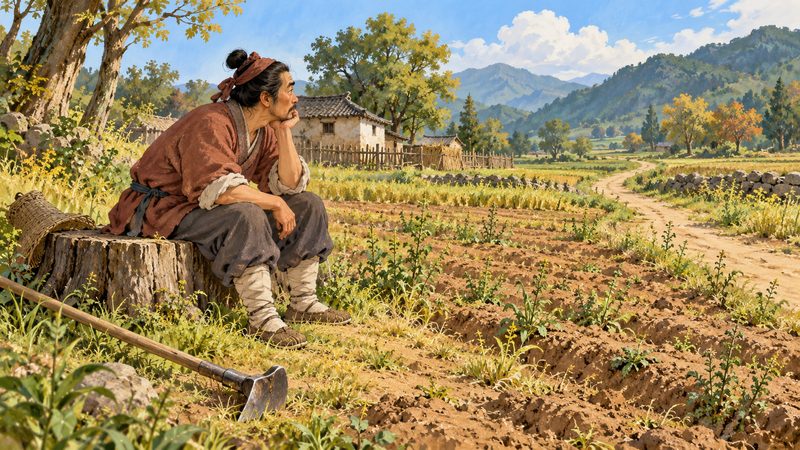
Picture question: What could the farmer be doing instead? The empty path and unused hoe help you discuss the choice. The illustration leaves out the rabbit’s injury and focuses on the later waiting.
Original modern example: A student once guessed a quiz answer correctly, then decides to stop preparing and rely on guesses. A friend might say, “不能总是守株待兔,还是要认真准备。” The parallel is expecting a chance success to replace preparation.
Do not use this lesson to label every careful wait as foolish.
掩耳盗铃: covered ears do not silence the bell
- Read it
- yǎn ěr dào líng · traditional: 掩耳盜鈴
- Literal image
- Cover the ears while stealing a bell.
- Meaning here
- Deceive yourself by treating an unwanted fact as if it has disappeared.
Someone wants to take a bell that is too large to carry away. He tries to break it, and the noise alarms him. He covers his own ears, although that cannot stop other people hearing it.
There is a useful source detail to notice. The MOE entry for 掩耳盜鈴 explains that the source uses 鍾, meaning a large bell, rather than the 鈴 in the familiar expression. It attributes the tale to Lu Shi Chun Qiu, “Bu Gou Lun: Zi Zhi.”
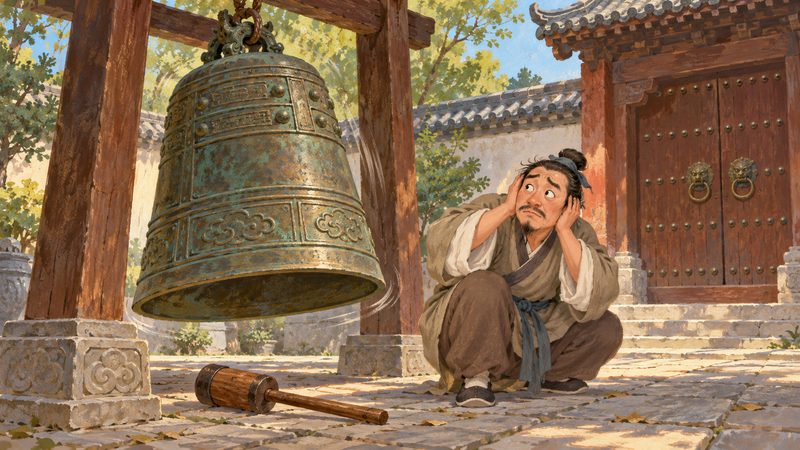
Picture question: Which problem has actually been solved? Pointing to the hands explains the action; explaining why the bell remains audible supplies the meaning.
Original modern example: A project organiser deletes an error from a presentation but leaves the underlying figures unchanged. A colleague says, “只删掉这一页,不改数据,是掩耳盗铃。” Hiding the visible reminder has not corrected the problem.
Move from the old scene to a modern situation
Now close the story text and choose a new situation for each picture. Keep the same decision pattern while changing the objects. A needless slide added to a clear presentation might fit 画蛇添足. A plan based only on last time’s lucky break might fit 守株待兔. Ignoring evidence while insisting a problem is gone might fit 掩耳盗铃.
Test the match by completing this sentence: “This is like the story because…” An answer such as “both have an animal” is too broad. A stronger answer identifies the cause of the mistake: an unnecessary addition, an unreliable expectation, or self-deception.
Try one contrast too. Correcting a factual error in a poster is useful revision, so it does not become 画蛇添足 merely because you added words. Waiting for a scheduled delivery is not the same as abandoning effort for a lucky repeat. Covering your ears because a noise hurts does not by itself imply self-deception. Context determines whether the comparison works.
For a short reading session, choose one picture, retell the turning point in two sentences, then make one modern example and one counterexample. Keep the pinyin as a pronunciation aid and the English explanation as a meaning aid; neither replaces checking the Chinese expression in context.
Questions about illustrated Chinese idiom stories
Are these pictures historical evidence?
No. They are new interpretive illustrations of attributed tales. Clothing, scenery and poses are artistic choices, not evidence that the pictured event occurred or that every detail reconstructs a particular period.
Why does the bell picture show a large bell?
The MOE dictionary explains that the source tale uses 鍾, a large bell, although the familiar idiom uses 鈴. The illustration follows that source detail to make the carrying problem easier to understand.
Does 守株待兔 mean that all waiting is foolish?
No. This tale highlights relying on an accidental gain instead of useful effort. The dictionary also records a sense involving waiting for a target to arrive, so judge the expression from its surrounding context.
Should I memorize the English gloss as an exact translation?
Use it as a reading aid. A short English phrase can explain the central idea here, but another sentence may need different wording. Keep the Chinese form, the story pattern and the actual situation together.