Wei Yu Chou Mou (未雨绸缪) means preparing before trouble arrives rather than waiting for damage. Its source image is a bird strengthening its nest before rain. It is not the story of the ruler of Yelang.
Wei Yu Chou Mou Meaning: Quick Answer
Use 未雨绸缪 for concrete preparation made in advance: checking a roof before heavy rain, saving a copy of your work before a device fails, or arranging a backup before a project begins. Worry alone is not preparation; the phrase points to preventive action.
Basic Facts
| Pinyin | wèi yǔ chóu móu |
|---|---|
| Literal image | Strengthening the nest before rain |
| Story setting | The bird’s voice in Chi Xiao, a poem in the Book of Odes |
| Modern use | the idiom explains preparing before trouble arrives rather than waiting for damage |
| Sentence fit | An action taken before a foreseeable difficulty occurs |
| Source boundary | The later idiom draws on the poem’s image; the poem does not contain the exact modern four-character phrase |
The bird and nest in the source poem
The source is Chi Xiao (鸱鸮), in the Bin Feng (豳风) section of the Shijing, or Book of Odes. A bird describes the work of protecting its nest. Before rain arrives, it takes material from mulberry roots and binds the nest’s openings more securely.
The Ministry of Education’s idiom dictionary reproduces the source lines: 迨天之未陰雨,徹彼桑土,綢繆牖戶。
In this context, the image is preparing and reinforcing before bad weather. 未雨绸缪 is a later expression based on that image, not an exact quotation of four consecutive characters from the poem.
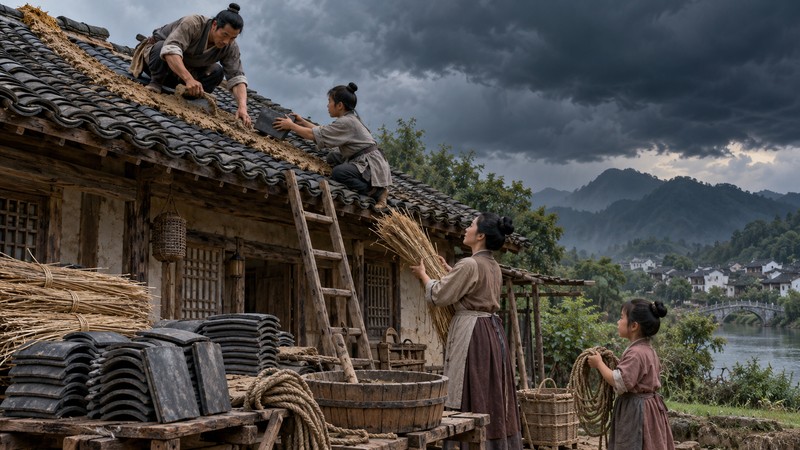
The roof-repair illustration is a modern parallel to the nest image: strengthening a shelter before heavy rain. It does not depict the bird in the poem or a documented historical household.
Pinyin and character notes
Read it as wèi yǔ chóu móu: fourth, third, second, and second tones. 未 means not yet; 雨 refers to rain. 绸缪 is the paired expression for binding closely, extended here to making something secure. The traditional form is 未雨綢繆. Do not replace 缪 with 谬.
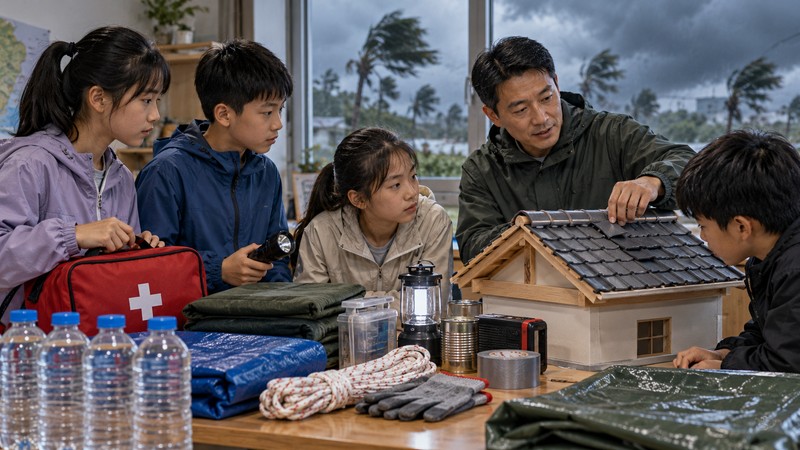
A lesson can connect the source image to an action students recognize. Checking supplies before a storm is different from merely saying that a storm may come. In the illustration, the teacher and students examine a model roof and preparation materials; this is a modern learning example.
Modern examples and sentence fit
为了防止文件丢失,我们未雨绸缪,提前做好了备份。
Meaning: To prevent losing the files, we prepared in advance and made a backup. The preventive action happens before the possible loss.
比赛还没开始,教练就未雨绸缪,安排好了替补队员。
Meaning: Before the match began, the coach planned ahead and arranged substitute players. This is an illustrative example, not a report of a particular match.
A project team can likewise check a backup system before launch. If the server has already failed and the team is only now trying to recover files, that action is a response to an existing problem, not the advance preparation described by 未雨绸缪. Name both the possible difficulty and the action taken beforehand when using the phrase.

Quick reference
The key is preparation before the problem, not confidence that nothing can go wrong. Continue with Chinese idioms in English or Chinese idioms for kids for more story-to-usage connections.
Frequently Asked Questions
Does the source poem contain the exact phrase Wei Yu Chou Mou?
No. The later four-character idiom draws on the poem’s description of strengthening a nest before rain; it is not an exact four-character quotation from that passage.
Does worrying in advance count as Wei Yu Chou Mou?
Not by itself. The expression describes preparation, such as making a backup before a file is lost, rather than only imagining a possible problem.
Illustrations show explanatory modern examples, not historical photographs or records of the source poem.