Chinese idioms for love with stories do not all describe the same relationship. 青梅竹马 recalls childhood companionship, 举案齐眉 praises respect between spouses, 琴瑟和鸣 evokes marital harmony, and 相濡以沫 describes people sustaining each other through hardship. Their stories and source images explain why one expression can fit a wedding toast while another may sound too solemn—or simply mean something broader than romance.
Four love idioms at a glance
| Expression | Pinyin | Core idea | Best fit |
|---|---|---|---|
| 青梅竹马 | qīng méi zhú mǎ | childhood companions | A couple or friends who knew each other as children |
| 举案齐眉 | jǔ àn qí méi | respect between spouses | Formal praise for a mutually respectful marriage |
| 琴瑟和鸣 | qín sè hé míng | marital harmony | Wedding wishes and literary descriptions of a harmonious couple |
| 相濡以沫 | xiāng rú yǐ mò | support in hardship | A long relationship tested by difficult circumstances |
These are fixed expressions used in modern Chinese, but the wording, story type, and later interpretation are different in each case. A poem supplies the image behind 青梅竹马; a historical biography tells the story behind 举案齐眉; the Book of Odes supplies the musical image associated with 琴瑟; and a philosophical parable provides 相濡以沫.
1. 青梅竹马: childhood companions who grow up together
- Characters
- 青梅竹马
- Pinyin
- qīng méi zhú mǎ
- Literal images
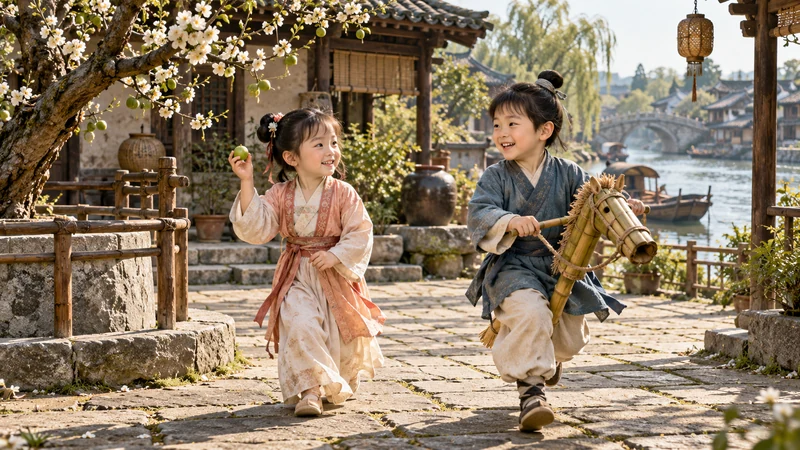
- green plums and a bamboo horse
- Modern sense
- people who were close childhood companions, sometimes with a later romantic relationship
The poem behind the expression
The familiar images come from Li Bai’s “Two Ballads of Changgan”. The speaker remembers playing near the gate with green plums while the boy rode a bamboo horse and circled the well-side railing. The poem then follows separation, longing, and the hope of reunion within a marriage.
The later four-character expression joins those two childhood images. In present use, 青梅竹马 can describe a boy and girl who grew up together, especially when the relationship later becomes romantic. It can also point to childhood closeness without promising that the pair married.
How to use it
Example: 他们从小一起长大,是大家眼中的青梅竹马。
They grew up together and are childhood sweethearts in everyone’s eyes.
Usage boundary: Do not use 青梅竹马 merely because two adults met when they were young. The expression normally suggests shared childhood experience and long familiarity. It also does not prove that the relationship became romantic.
2. 举案齐眉: respect within marriage
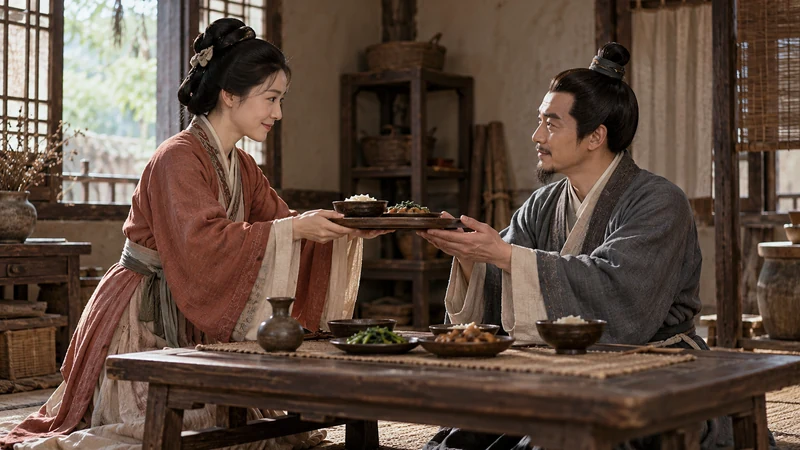
The story of 梁鸿 (Liang Hong) and 孟光 (Meng Guang) is recorded in the Book of Later Han. A compact Chinese Text Project reference entry summarizes the traditional account: when Meng Guang brought food to her husband, she raised the tray to eyebrow level. Later readers took the gesture as an emblem of respect between spouses.
- Characters
- 举案齐眉
- Pinyin
- jǔ àn qí méi
- Literal action
- raise the serving tray to eyebrow height
- Modern sense
- spouses treating each other with deep respect
In modern writing, 举案齐眉 is usually positive and formal. It may appear in a wedding speech, an anniversary tribute, or a biography of a long-married couple. The useful idea is respect maintained inside a close relationship.
Example: 两人结婚多年,仍然互相尊重,举案齐眉。
After many years of marriage, they still treat each other with respect and consideration.
Usage boundary: The ancient scene reflects its own social setting. When using the idiom today, explain it through mutual respect; do not present the tray gesture as a required model for one spouse’s obedience.
3. 琴瑟和鸣: two instruments sounding in harmony
琴 (qín) and 瑟 (sè) are distinct stringed instruments. The Book of Odes repeatedly uses their paired sound as an image of concord. In “The Cry of the Ospreys,” the line 琴瑟友之 connects the instruments with harmonious companionship; elsewhere, the collection uses 琴瑟 in descriptions of household and family concord.
- Characters
- 琴瑟和鸣
- Pinyin
- qín sè hé míng
- Literal image
- the qin and se sounding harmoniously
- Modern sense
- a harmonious marriage or well-matched couple
琴瑟和鸣 is especially natural in ceremonial language. It praises coordination and harmony, rather than the intensity of courtship. A wedding card may use it as a wish; a family history may use it to describe a marriage.
Example: 祝你们琴瑟和鸣,携手走过每一个春秋。
May your marriage be harmonious as you walk through every season together.
Usage boundary: This phrase is elevated and marriage-centered. It will usually sound too ceremonial for a casual dating message, and it should not be translated as though 琴 and 瑟 were the same instrument.
4. 相濡以沫: helping each other through hardship
In the “Great and Most Honoured Master” chapter of the Zhuangzi, fish stranded in a dry place moisten one another with breath and foam. The passage then says it would be better for them to forget each other in rivers and lakes. The full comparison is philosophical: it contrasts desperate mutual aid under constraint with freedom in a larger natural order.
- Characters
- 相濡以沫
- Pinyin
- xiāng rú yǐ mò
- Literal image
- moistening one another with foam
- Modern sense
- supporting one another when circumstances are hard
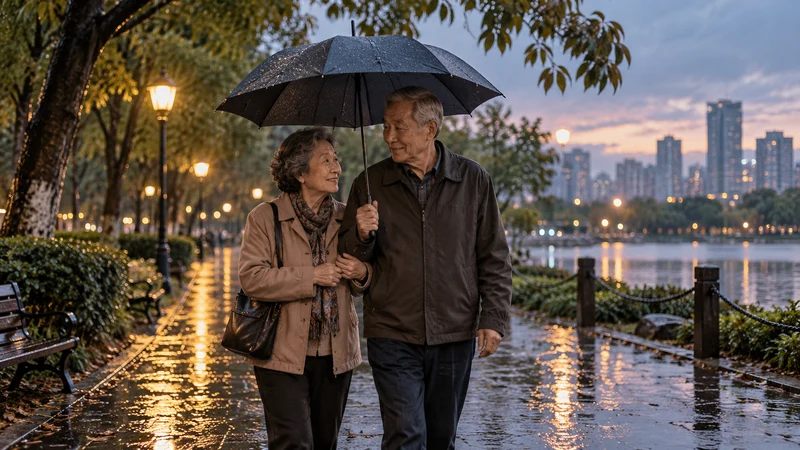
Modern Chinese often uses 相濡以沫 warmly for spouses who endured illness, poverty, displacement, or other hardship together. That use is understandable, but the classical passage is broader than romantic devotion and contains a second idea that short quotations often omit.
Example: 最艰难的几年里,他们相濡以沫,从未放弃彼此。
During the hardest years, they supported each other and never gave up on one another.
Usage boundary: Use it when real difficulty matters to the sentence. For an ordinary happy date or a new relationship, it can sound heavier than intended. It can also describe mutual aid outside romance.
How to choose the right expression
- Choose 青梅竹马 when the shared childhood is the central fact.
- Choose 举案齐眉 when you want to praise respectful conduct between spouses.
- Choose 琴瑟和鸣 for marital harmony, especially in formal wishes.
- Choose 相濡以沫 when a couple or group has supported one another through genuine hardship.
For a broader themed list, see our Chinese idioms for love printable. You can also compare these expressions with friendship idioms and their stories, then practice the grammar patterns in our guide to Chinese idioms in sentences.
Data anchor: source and translation notes
The story summaries use the cited classical or reference texts. English glosses explain modern usage; they are not presented as single definitive translations. 青梅竹马 and 琴瑟和鸣 developed from literary images, 举案齐眉 from a biographical anecdote, and 相濡以沫 from a philosophical parable. Keeping those source types separate prevents a modern love-themed list from turning every expression into the same kind of romance story.
Frequently asked questions
What is a Chinese idiom for childhood sweethearts?
青梅竹马 is the best-known expression. It refers to people who were close companions in childhood and can imply a later romance, but it does not guarantee that they became a couple.
Which Chinese idiom is suitable for a wedding card?
琴瑟和鸣 is a natural formal wish for marital harmony. 举案齐眉 can also praise mutual respect between spouses, but it sounds more like a description or tribute than a short celebratory wish.
Does 相濡以沫 only describe romantic love?
No. Modern usage often describes couples supporting each other through hardship, but the expression can apply more broadly to people helping one another under difficult conditions.
Are these expressions interchangeable?
No. They emphasize different relationships and circumstances: childhood familiarity, spousal respect, marital harmony, or mutual aid in hardship. Choose the expression whose source image matches the point you need to make.