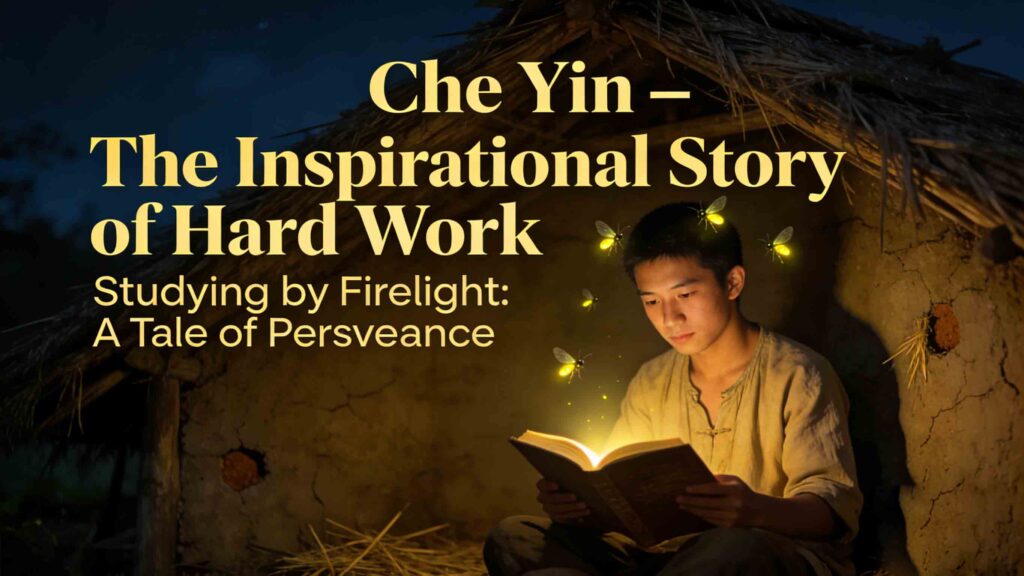
Che Yin is one of the most well-known figures in traditional Chinese inspirational stories because his name is tied to the image of studying by firefly light. For searchers who only know the name Che Yin, the important point is simple: the story praises disciplined learning when a student has almost no material resources.
Quick Answer: Who Was Che Yin?
Che Yin was a poor but determined Chinese scholar remembered for studying at night by the light of fireflies when his family could not afford lamp oil. In English, the Che Yin story is usually used to explain diligence, self-study, and finding a way to keep learning despite difficult conditions.
Basic Facts About Che Yin
| Person | Che Yin, a diligent scholar in a traditional Chinese learning story |
| Main image | Studying at night with firefly light |
| Core meaning | Persistent learning when resources are limited |
| Best use | Teaching diligence, study habits, and classical Chinese moral stories |
His story tells us that even in difficult conditions, we can still study hard and achieve great things.
Many people search for this story because his story has become a symbol of perseverance and love for learning.
It is often told to children to encourage them to value study and never give up.
The Story of Che Yin
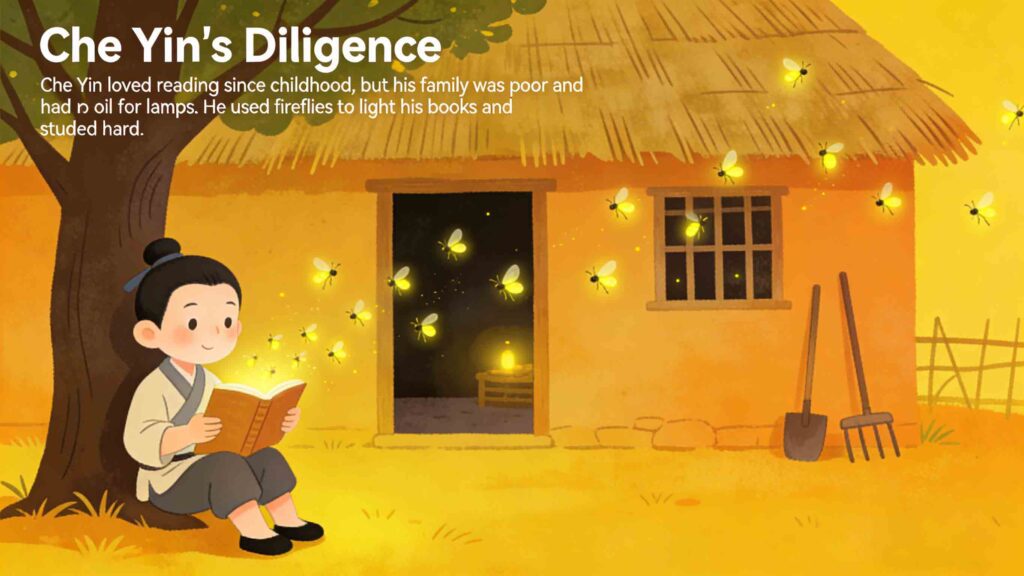
Che Yin lived in ancient China. His family was very poor and could not afford oil for lamps.
At night, he had no light to read books.
But Che Yin loved learning so much that he did not want to stop studying.
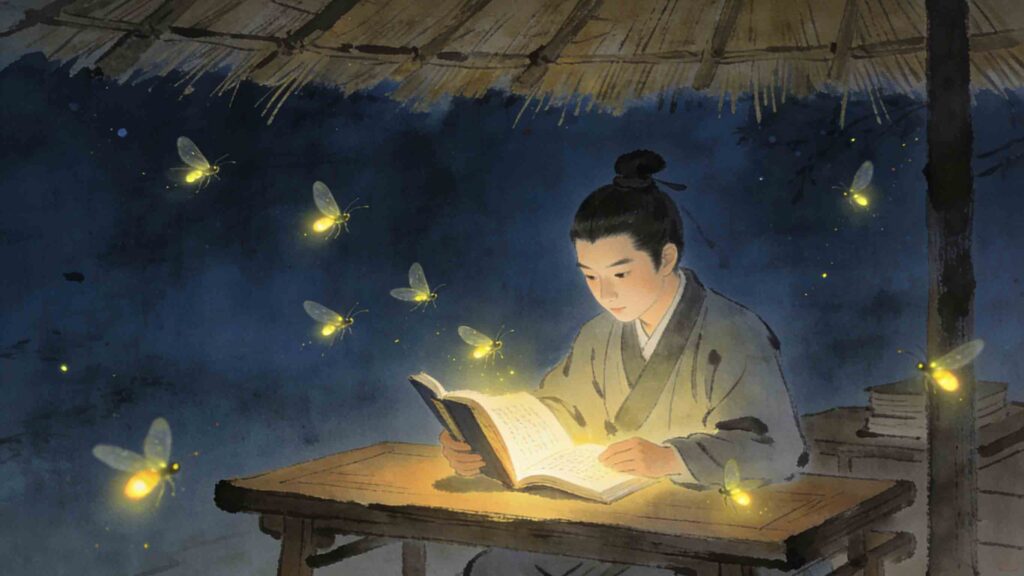
He caught fireflies and put them into a small cloth bag.
The light from the fireflies became his “reading lamp” at night.
Using this weak light, he kept reading and studying every night.
He never complained about his hard life. Instead, he used his wisdom to solve problems.
What the Che Yin Story Means for Learners
The Che Yin story is not mainly about fireflies as a magic solution. Its lasting meaning is that a learner can stay disciplined even when the normal study conditions are missing. That is why English readers often connect Che Yin with perseverance, poverty, self-study, and respect for education.
For children, the story works best when it is explained in three steps: Che Yin wanted to study, his family could not afford lamp oil, and he found a humble way to keep reading at night. The lesson should not be that students must suffer. The better lesson is that attention, effort, and steady habits matter more than perfect tools.
Teachers can also compare Che Yin with other Chinese learning stories. Some stories praise clever methods, some praise patience, and some warn against giving up too quickly. Che Yin belongs to the group that values persistence under constraint. When students understand that category, the story becomes easier to remember than a simple name-and-date fact.
A useful classroom question is: what is the modern version of studying by firefly light? The answer might be using a library, sharing books, reviewing notes after school, or practicing a little each day even when the schedule is busy. This keeps the ancient story connected to real study behavior instead of leaving it as a distant moral tale.
Why Che Yin’s Story Is So Important
The story of this diligent scholar teaches us several important lessons:
- Where there is a will, there is a way.
- Diligence can overcome difficulties.
- A true love for learning helps us grow.
Today, parents and teachers still use the story of this young scholarto educate children.
It shows that success does not come easily. It comes from hard work and persistence.
Che Yin and Traditional Chinese Culture
Che yin represents the spirit of studying hard in Chinese culture.
His story is included in many classic texts and idiom materials for students.
It helps young learners understand traditional values and positive qualities.
Whether you are teaching children Chinese culture or looking for inspirational stories,
the story of che yin is always a good choice.
For more classic tales for young learners, explore our 15 Kids Chinese Idiom Stories Pack – perfect for introducing children to traditional wisdom through fun, easy-to-read stories.
For guided reading and practice, the Che Yin bilingual printable PDF includes pinyin, English explanation, cultural notes, and exercises.
If you love stories about hard work and perseverance, check out our 10 Diligence Stories Pack – featuring inspiring tales of persistence and dedication.
For more background on traditional Chinese inspirational stories, you can refer to the Wikipedia entry on Nang Ying Ying Xue.
Quick Reference for Learning This Story
If you are comparing Che Yin with other learner-friendly stories, start with Chinese chengyu stories, the broader Chinese idiom stories collection, and Chinese four-character idioms. Those pages help connect the Che Yin story with pinyin, meaning, and classroom practice.
How to Read the Firefly-Light Lesson Without Overstretching It
The firefly-light episode is memorable because it gives a concrete picture to an abstract value. A child can imagine a dark room, a student who still wants to read, and a small natural light that makes one more page possible. That picture is stronger than a plain sentence such as “work hard,” because it gives the learner a scene to remember.
At the same time, the lesson should be taught with care. The story should not be used to romanticize poverty or suggest that children should ignore rest, health, or safety. A better reading is practical: when conditions are imperfect, a learner can still look for a reasonable next step. That might mean asking for help, using a library copy, reviewing notes in shorter sessions, or choosing one small task instead of giving up completely.
This distinction matters for English readers because classical Chinese learning stories often sound severe when translated too literally. Many of them praise discipline, but they also depend on context: family duty, respect for books, examination culture, and the old belief that education could change a person’s life. Explaining those layers makes the moral clearer and less mechanical.
For a short lesson, ask students to name the obstacle, the action, and the value. The obstacle is the lack of lamp oil. The action is finding a small source of light. The value is not simply “study longer,” but “protect the habit of learning.” That three-part reading keeps the story concrete and avoids turning it into a vague slogan.
For pronunciation and translation, keep the learner’s goal modest. It is enough to remember the name, the night-study scene, and the meaning before comparing versions in different books or classroom materials. If a source gives extra historical details, treat them as background unless the lesson is specifically about history. That keeps the page useful for beginners, parents, and teachers who mainly need a clear explanation.
How This Story Compares With Other Study Tales
Many classical study tales follow a similar pattern: a young learner faces a practical obstacle, chooses a disciplined response, and later becomes a model for others. The value of comparing stories is that students can see different kinds of effort. One tale may show patience over many years. Another may show creative use of a small resource. Another may show respect for teachers, books, or family expectations.
When building a lesson plan, avoid asking students to memorize every story as an isolated moral example. A better method is to group stories by the problem they solve. Ask whether the obstacle is poverty, distraction, fear, laziness, lack of confidence, or lack of guidance. Then ask what action changes the situation. This creates a practical reading habit: learners notice cause, action, result, and value.
Parents can use the same approach at home. Instead of saying “work harder” after reading the story, ask a concrete question: what is one small study habit that would make tomorrow easier? The answer might be preparing books before bedtime, reviewing five vocabulary cards, reading one short paragraph aloud, or keeping a notebook for difficult words. The old story then becomes a tool for building manageable routines.
This comparison also protects the story from becoming a flat slogan. Traditional tales are most useful when they create a clear mental image, a simple sequence, and a realistic next step. That is why a balanced explanation can help both adult learners and children understand the cultural value without losing the practical lesson.
A final useful check is whether the learner can retell the story without copying the exact wording. A strong retelling should include the setting, the problem, the improvised solution, and the broader study value. If those four parts are clear, the learner has understood the cultural point rather than only memorizing a sentence. This makes the story easier to compare with other Chinese moral tales and easier to use in discussion, writing practice, or bilingual reading lessons.
For independent study, the same framework can be reused after reading: scene, obstacle, choice, and lesson. This keeps review short, concrete, and easy to repeat without turning the story into memorized wording.
A Simple Reading Routine After the Story
After reading, learners can use a short routine to make the lesson stick. First, retell the story in one sentence. Second, name the difficulty in plain words. Third, describe the action that changed the situation. Fourth, connect the value to a modern habit. This routine is short enough for a child, but it also helps adult learners avoid treating the story as a decorative cultural anecdote.
The same routine can support writing practice. A student might write: “The obstacle was darkness; the response was finding a small source of light; the value was keeping a study habit.” Another student might connect the lesson to keeping notes, reviewing vocabulary, asking a teacher for help, or using limited free time more deliberately. These small exercises make the cultural story useful without forcing a heavy moral tone.
For comparison work, pair this story with another learning tale and ask what changes. Does the second story focus on patience, memory, courage, respect, or planning? A comparison like that helps readers see Chinese moral stories as a network of examples rather than isolated slogans. It also gives the page a clearer learning purpose for parents, teachers, and independent students.
Che Yin FAQ
What is Che Yin famous for?
Che Yin is famous for the traditional story of studying at night by firefly light when his family could not afford lamp oil. The story is remembered as an example of diligence and love of learning.
What does the Che Yin story teach?
It teaches that difficult conditions do not have to stop steady learning. In a modern lesson, the practical message is persistence, resourcefulness, and keeping a study habit even when resources are limited.
Is Che Yin a chengyu or a historical story?
Che Yin is best understood as a traditional figure in an inspirational learning story. The story is often taught alongside chengyu and classical moral tales because it carries a compact cultural lesson.
{ “@context”: “https://schema.org”, “@type”: “FAQPage”, “mainEntity”: [ { “@type”: “Question”, “name”: “What is Che Yin famous for?”, “acceptedAnswer”: { “@type”: “Answer”, “text”: “Che Yin is famous for the traditional story of studying at night by firefly light when his family could not afford lamp oil.” } }, { “@type”: “Question”, “name”: “What does the Che Yin story teach?”, “acceptedAnswer”: { “@type”: “Answer”, “text”: “The story teaches persistence, resourcefulness, and steady learning when resources are limited.” } }, { “@type”: “Question”, “name”: “Is Che Yin a chengyu or a historical story?”, “acceptedAnswer”: { “@type”: “Answer”, “text”: “Che Yin is best understood as a traditional figure in an inspirational learning story that is often taught alongside chengyu and classical moral tales.” } } ] }