Chinese idioms from history often preserve a memorable action or a warning from an older narrative. Learning the story helps, but the familiar four-character expression and the account behind it are not always the same piece of text.
Compare three examples below: 破釜沉舟, 纸上谈兵, and 卧薪尝胆. Each has a useful modern meaning. Each also gives you a reason to distinguish a dictionary explanation, a passage from an older work, and a modern retelling written for learners.
| Idiom | Pinyin | Modern use |
|---|---|---|
| 破釜沉舟 | pò fǔ chén zhōu | A determination that cuts off retreat |
| 纸上谈兵 | zhǐ shàng tán bīng | Discussion detached from practical conditions |
| 卧薪尝胆 | wò xīn cháng dǎn | Determined self-discipline after a setback |
The source accounts discussed here are passages in the Shiji, traditionally attributed to Sima Qian, as quoted in Taiwan’s Ministry of Education Dictionary of Chinese Idioms. They are historical narratives to read critically, not a claim that a modern illustration or simplified dialogue documents an event.
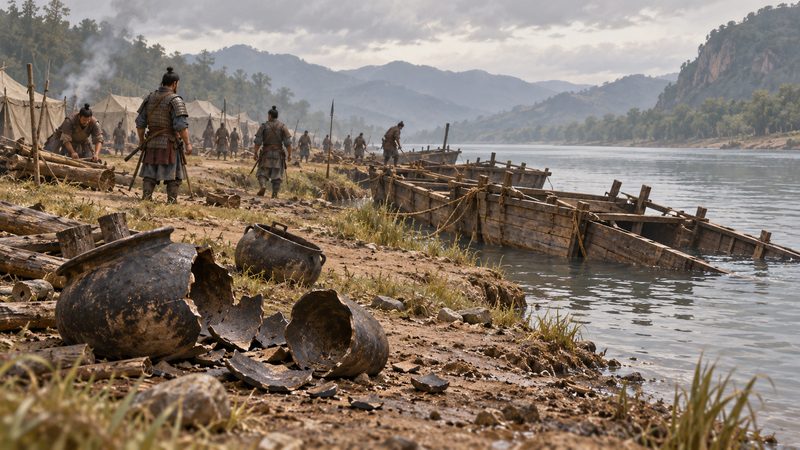
Compare 破釜沉舟 with its source wording
The literal image is breaking cooking pots and sinking boats. The dictionary’s 破釜沉舟 entry connects it with the account of Xiang Yu in Shiji, chapter 7. In the quoted passage, his force crosses a river, sinks the boats, breaks cooking vessels, and carries limited provisions. The story makes retreat seem unavailable.
The modern expression emphasizes commitment and resolve. It is stronger than simply deciding to try. In an original practice sentence, 这次转型,公司拿出了破釜沉舟的决心。 means “For this change of direction, the company showed an all-or-nothing determination.” The sentence describes intensity; it does not tell the reader whether the decision was wise.
When retelling the episode, separate the account’s actions from the modern idiom that summarizes them. You can explain the connection without inventing a speech in which Xiang Yu announces the four-character phrase.
Compare 纸上谈兵 with the older Zhao Kuo account
纸上谈兵 literally evokes discussing military matters on paper. The dictionary’s entry on 紙上談兵 points to the Zhao Kuo narrative in Shiji, chapter 81. The quoted account contrasts his confidence in discussing warfare with an inability to adapt in command.
Today the phrase criticizes an argument or plan that does not engage with practical conditions. For example, 先做一次小规模测试,别只纸上谈兵。 means “Run a small test first; do not just discuss it in the abstract.” This is an original modern example, not a line from the ancient account.
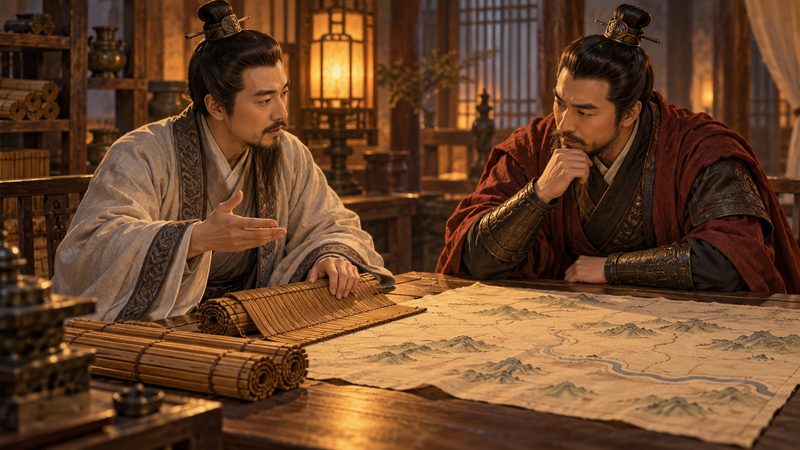
The idiom does not mean that reading or theory is useless. Its criticism is the gap between discussion and application. That distinction matters when using it about a student or colleague: criticize the missing practical test rather than treating all study as empty talk.
Compare 卧薪尝胆 with the quoted source passage
The familiar story combines lying on firewood with tasting bitterness. The dictionary’s 臥薪嘗膽 entry associates it with Goujian, king of Yue, and quotes Shiji, chapter 41. That quoted passage describes a bitter reminder and strenuous effort after his return.
There is a useful source-reading distinction here. The dictionary’s explanatory retelling includes the firewood scene; the older passage it quotes does not describe that scene. Do not turn every detail of the explanatory story into a direct quotation from the quoted passage.
In modern figurative usage, the phrase can describe determined effort after a setback. 失利后,他卧薪尝胆,认真准备下一次比赛。 means “After the defeat, he applied himself with determination and prepared carefully for the next competition.” This example describes sustained effort, not a literal instruction to imitate the story.
Choose what belongs in your historical retelling
Keep three notes for each idiom: its current meaning, the older work linked to the episode, and the details your chosen source actually states. Mark invented dialogue as your own dramatization. If you shorten an account, keep the action that explains the idiom rather than adding a more exciting ending.
Then try a modern sentence with a clear situation.

Questions about historical idioms
Does an idiom’s source always contain the exact four characters?
No. A source may provide the episode or idea that a later expression summarizes. Check the quoted wording before treating the idiom itself as a direct quotation.
Are all chengyu based on historical events?
No. An idiom may also be associated with a fable, a literary passage, or another kind of traditional expression. These three examples focus on historical narratives.
Are the simplified and traditional forms different idioms?
Not in these examples. 紙上談兵 and 纸上谈兵, and 臥薪嘗膽 and 卧薪尝胆, are corresponding written forms of the same expressions.
Can I use these stories as literal advice?
Use the modern figurative meaning and judge the situation separately. An idiom about determination or impractical talk does not prove that a specific real-world decision is sound.