Lan Yu Chong Shu (濫竽充數 / 滥竽充数, làn yú chōng shù) describes an unqualified person passing as capable by hiding inside a group. It can also describe inferior work or goods used merely to fill a quota. The idiom comes from the story of a man who pretended to play the yu in a royal ensemble but fled when musicians had to perform alone.
Quick Answer
滥竽充数 means pretending to have ability while blending into a group of qualified people. In modern English, “making up the numbers,” “passing oneself off as qualified,” or “coasting in a group” may fit, depending on context. The phrase is usually critical, but it can occasionally be used as self-deprecating language. Taiwan’s Ministry of Education dictionary records the pronunciation and both the “unqualified person among experts” and “inferior item filling a place” senses in its entry for 濫竽充數.
Basic Facts
| Chinese | 濫竽充數 (traditional); 滥竽充数 (simplified) |
|---|---|
| Pinyin | làn yú chōng shù |
| Literal image | An incapable yu player filling a place in an ensemble |
| Source | Han Feizi, “Inner Congeries of Sayings, Upper Series” (《韓非子·內儲說上》) |
| Modern use | Someone without the required skill conceals that weakness inside a group; sometimes an inferior item merely fills a quota |
| Tone | Usually negative; sometimes self-deprecating |
The Story Behind 滥竽充数
According to Han Feizi, King Xuan of Qi required a large group of three hundred people when the yu was played. A man identified as Master Nanguo (南郭處士) asked to join the royal musicians and received provisions like the others, even though the story implies that he could not actually play.
After King Xuan died, King Min took the throne. The new king preferred to hear the musicians one at a time. An individual performance would expose Master Nanguo immediately, so he fled. The contrast between group performance and solo performance is the point of the story: his apparent qualification survived only while the group concealed him.
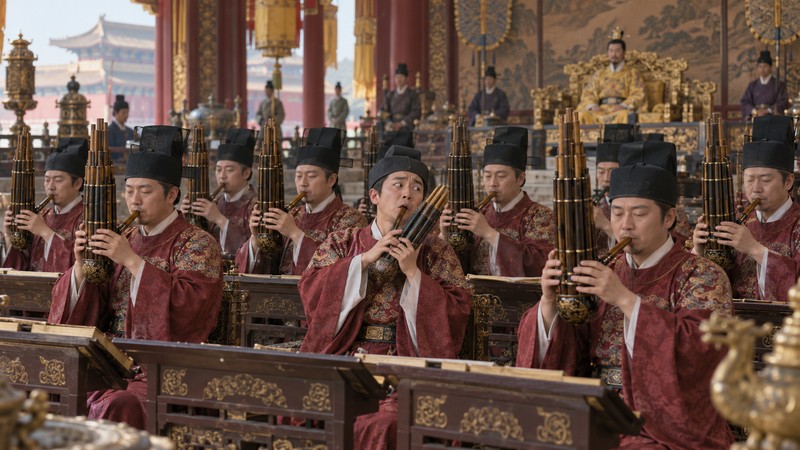
The cited Han Feizi passage and an explanation of its provision detail can be checked in the Ministry of Education’s Chengyu Dictionary entry for 濫竽充數. Retellings often add visual detail, but the stable sequence is the large ensemble, the change to solo performance, and Master Nanguo’s flight.
Pinyin and Character Notes
The pronunciation is làn yú chōng shù:
- 濫 / 滥 (làn): indiscriminate, excessive, or unqualified in this expression
- 竽 (yú): an ancient reed mouth organ
- 充 (chōng): to fill or serve as
- 數 / 数 (shù): number or quota here
The last character is read shù, not shǔ. The phrase is therefore not about counting instruments. It pictures someone unqualified occupying a place so that the required number appears complete.

How to Use Lan Yu Chong Shu Today
In the story-related person sense, 滥竽充数 describes someone who lacks a required skill but passes as capable while a group hides the gap. The idiom can also describe inferior material used merely to fill a place or quota, as in the report example below; that use does not require a person hiding in a group. Speakers sometimes use the phrase modestly about their own contribution. A beginner who openly asks for guidance is not necessarily pretending to be qualified.
Examples that fit
- 他不会演奏,却一直混在乐团里滥竽充数。
He could not play, but kept blending into the orchestra as if he could. - 这份报告不能拿几段无关资料来滥竽充数。
This report should not be padded with irrelevant material merely to fill space. - When each programmer had to explain their own code, the colleague who had been 滥竽充数 could no longer hide behind the team.
Examples that do not fit
A trainee working under supervision, a new musician playing a simpler part, or a teammate contributing a smaller but clearly assigned task is not automatically 滥竽充数. The phrase implies concealment or substitution, not simply a difference in experience. It should also not be used as proof that a person is dishonest when their actual role and ability are unknown.

Quick Reference
- Core meaning: an unqualified person or inferior item fills a place while appearing acceptable
- Story test: is someone like Master Nanguo, protected by the group but exposed alone?
- Usage test: for the story-related person sense, is a lack of required skill being concealed? For things, is inferior material merely filling a place or quota? Is the speaker using the phrase modestly about their own contribution?
- Avoid: applying the idiom to honest beginners or people whose assigned role is simply smaller
For related learning paths, explore Chinese idioms for kids, read a Chinese idiom stories book, or compare more Chinese idioms in English.
Frequently Asked Questions
What does Lan Yu Chong Shu mean?
It means that an unqualified person passes as capable by hiding within a group. It may also describe inferior material used only to fill a quota.
Who was Master Nanguo?
In the story recorded in Han Feizi, Master Nanguo joined a large royal yu ensemble and received provisions, but fled when the new king required individual performances.
What kind of instrument is a yu?
A yu (竽) is an ancient Chinese reed mouth organ. The instrument matters because the story concerns a royal ensemble of yu players.
Can 滥竽充数 describe a beginner?
Not merely because someone is inexperienced. The idiom fits when the person conceals a lack of required ability or occupies a place under a false impression of competence.