Quick Answer: Chinese idioms about travel do different jobs. 一路顺风 wishes someone a smooth journey; 千里迢迢 emphasizes how far someone has come; 跋山涉水 emphasizes a difficult journey; and 走马观花 describes a hurried or superficial look. Choose what you want to say before choosing an expression that happens to contain travel imagery.
A farewell message, an account of a long trip and a comment on rushed sightseeing are different kinds of sentences. Mixing their idioms can change a warm wish into a description of hardship, or make an intended compliment sound like criticism. The comparison below gives the characters, Mandarin pinyin and a small context for each.
Compare Four Travel Meanings at a Glance
Basic Facts: Meaning and Best-Fit Context
| Expression | Mandarin pinyin | What it emphasizes | Best-fit sentence |
|---|---|---|---|
| 一路顺风 / 一路順風 | yī lù shùn fēng | A wish for a smooth journey | Saying goodbye before departure |
| 千里迢迢 | qiān lǐ tiáo tiáo | Great distance | Someone coming from far away |
| 跋山涉水 | bá shān shè shuǐ | The effort of arduous travel | A journey involving real difficulty |
| 走马观花 / 走馬觀花 | zǒu mǎ guān huā | A quick, surface-level look | Seeing a place without exploring deeply |
The pinyin here uses dictionary citation tones. In normal speech, the 一 in 一路顺风 is pronounced yí before the fourth-tone lù; the dictionary records that change too. The other examples below are original teaching sentences, not quotations from historical texts.

Which Phrase Sends Someone Off?
一路顺风 literally pictures favorable wind along the route. Its modern job is to wish someone a safe, smooth trip. The Ministry of Education’s dictionary entry identifies it as a farewell blessing and includes an air-travel example. It is not restricted to a sailing voyage.
Example: 姐姐明天出发,祝她一路顺风。
Jiějie míngtiān chūfā, zhù tā yī lù shùn fēng.
“My older sister leaves tomorrow. I wish her a smooth journey.”
In that sentence, the speaker is offering a wish. They are not reporting that the journey has already gone well. Keep that difference clear when translating it into English: “Have a good trip” fits the function better than a weather report.
Which Phrase Emphasizes Distance?
千里迢迢 combines the image of a thousand li with a repeated word expressing remoteness. The dictionary definition is about a long distance. It does not require you to calculate an exact thousand-li route before using it.
Example: 爷爷千里迢迢地来看我们。
Yéye qiān lǐ tiáo tiáo de lái kàn wǒmen.
“Grandpa came from far away to see us.”
This can acknowledge the effort involved in someone coming a long way, but its central emphasis is distance. It does not by itself tell the reader whether the traveler crossed rough terrain or rode comfortably. For help fitting an expression into an actual sentence, see our Chinese idioms in sentences guide.
Distance or Difficulty: Choose the Right Description
跋山涉水 pictures traveling over mountains and through water. Its modern dictionary meaning stresses the hardship of a long journey. Use it when the difficulty matters, rather than as a decorative replacement for every ordinary trip.
Example: 他们跋山涉水,终于到达了村庄。
Tāmen bá shān shè shuǐ, zhōngyú dàodá le cūnzhuāng.
“After an arduous journey, they finally reached the village.”
The sentence draws attention to what reaching the destination required. The literal picture helps explain the expression, but a modern use need not prove that the travelers crossed both a mountain and a river. Conversely, a short easy riverside walk does not become arduous merely because both features appear in a photograph.

When a Visit Is Only a Hurried Glance
走马观花 literally pictures viewing flowers while riding a horse. In the modern context used here, it means looking quickly without examining something deeply. It can describe rushed sightseeing, but also reading or inspection. It does not simply mean “having a lovely holiday.”
Example: 行程太紧,我们只是走马观花,没来得及仔细参观。
Xíngchéng tài jǐn, wǒmen zhǐ shì zǒu mǎ guān huā, méi láidejí zǐxì cānguān.
“The schedule was too tight: we only had a quick look and did not have time to explore carefully.”
The Horse-and-Flowers Allusion Is Not the Whole Meaning
The MOE idiom entry refers to the related form 走馬看花. It distinguishes imagery associated with Meng Jiao’s joyful poem after examination success from a later superficial-looking sense, cautiously associated with Wu Qiao’s discussion of poetry. Do not flatten those layers into a claim that the modern critical meaning was simply the poet’s original message.
If a child asks why a museum sentence contains a horse, explain the moving viewpoint first, then the present meaning. The scene is an aid to understanding, not a requirement that a horse appear in the real situation. Our guide to Chinese idioms from history explores the wider difference between a source image and later usage.
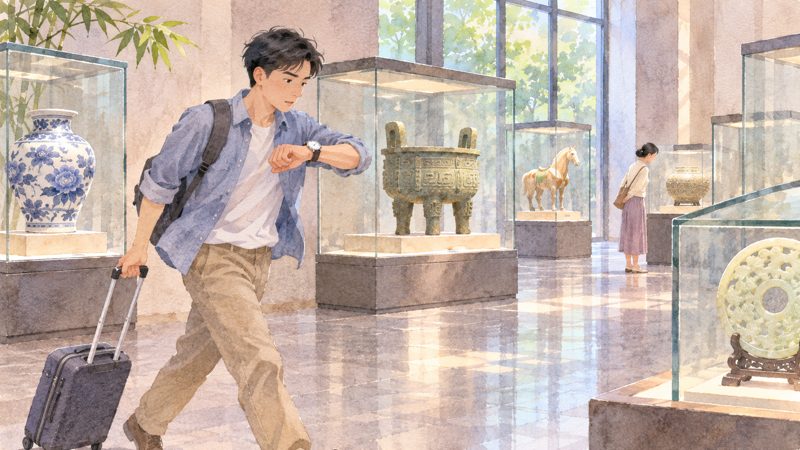
Quick Reference: Match the Sentence to Its Purpose
- A friend leaves tomorrow: choose a farewell wish, 一路顺风.
- A relative has come from far away: emphasize distance with 千里迢迢.
- Reaching a destination was arduous: consider 跋山涉水.
- There was no time to study a place closely: 走马观花 can describe that limitation.
For practice, tell one short travel scene in plain language first. Add the one idiom that contributes information instead of inserting all four. Then ask a listener what the idiom adds. Our idiom learning method uses context and recall to make that practice repeatable.
Questions About Chinese Travel Idioms
Can 一路顺风 be used before a flight?
Yes. The dictionary records it as a farewell blessing and gives an air-travel example. It is a wish for a smooth journey, not a literal forecast of wind conditions.
Does 千里迢迢 require exactly one thousand li?
No. Its idiomatic meaning emphasizes a long distance; it is not a precise route measurement.
Must 跋山涉水 include an actual mountain and river?
No. Those features explain the literal image, while the modern meaning stresses an arduous journey.
Are 走马观花 and 走马看花 pronounced the same?
No. They are related forms, but 观 is guān and 看 is kàn here. Read the character actually written rather than swapping the pronunciation.