Chinese food idioms for kids are easiest to teach when the literal food picture and the modern uses are checked separately. A drawn cake can represent something that looks useful but cannot meet a real need. A date swallowed whole can picture learning without careful understanding. Sour plums can stand for comfort created by imagination. 津津有味 can describe strong interest in a story, and later usage can also describe a hearty appetite or tasty food.
This lesson uses four idioms with tone-marked pinyin, a source-bound explanation, a plain English meaning, and a context check. The stories are traditional accounts attributed by the cited dictionary; the classroom examples and activities are new teaching aids. Simplified characters appear first, followed by the traditional form when it differs.
Quick answer: food is the picture, not always the meaning
Teach three layers: name the food image, explain the choice or result in the story, then test one modern situation. A child should be able to say why the idiom fits—not merely point to the same food.
| Idiom | Pinyin | Literal picture | Core modern use |
|---|---|---|---|
| 画饼充饥 / 畫餅充飢 | huà bǐng chōng jī | Draw a cake to satisfy hunger | Use an empty form or fantasy instead of something useful |
| 囫囵吞枣 / 囫圇吞棗 | hú lún tūn zǎo | Swallow a date whole | Accept or study something without understanding it carefully |
| 望梅止渴 | wàng méi zhǐ kě | Think of plums to ease thirst | Comfort oneself with imagination when the real need remains |
| 津津有味 | jīn jīn yǒu wèi | Full of flavor or relish | Show strong interest; later usage also covers hearty appetite or tasty food |
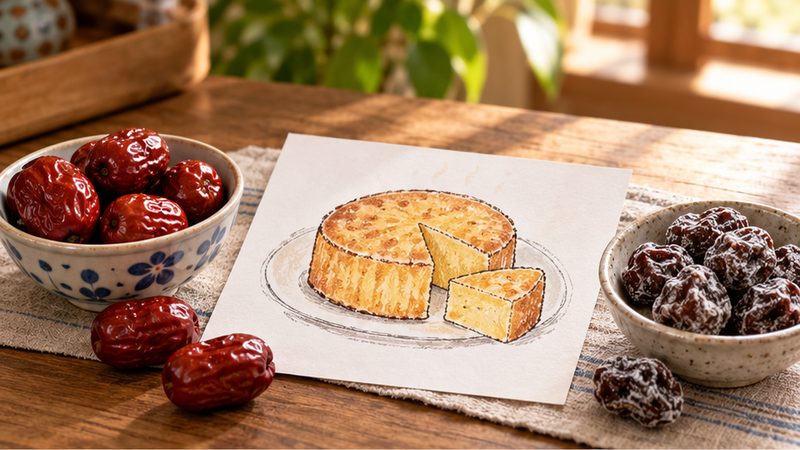
画饼充饥: a picture cannot replace the real thing
画饼充饥 · huà bǐng chōng jī
Traditional: 畫餅充飢
The Ministry of Education dictionary connects this expression with an account in Sanguozhi involving the selection of capable people. Reputation without real ability is compared with a cake drawn on the ground: it can be seen but not eaten. The modern expression can describe something that has an attractive form or comforting promise but gives no practical help.
Kid-friendly example: Leo writes “100” on an empty practice test but does not answer any questions. The number looks good, yet it does not create real learning. That is like 画饼充饥.
Near-miss: Drawing a cake as part of an art lesson is not the idiom. Nothing is pretending to solve hunger or replace real work.
囫囵吞枣: do not swallow an idea without understanding it
囫囵吞枣 · hú lún tūn zǎo
Traditional: 囫圇吞棗
The literal image is swallowing a date whole without chewing. The dictionary uses the expression for vague, uncritical understanding or study that never reaches the details. The lesson is not about table manners; it is about taking in information too quickly to distinguish what it means.
Kid-friendly example: Mia memorizes four characters from a flashcard but cannot explain the story or choose a fitting sentence. She has taken in the shape without understanding the idea, which resembles 囫囵吞枣.
Near-miss: Reading a short book quickly is not automatically careless. If the learner can explain the argument and evidence, speed alone does not prove the idiom.
望梅止渴: imagination can comfort but not solve the need
望梅止渴 · wàng méi zhǐ kě
The dictionary traces the story to Liu Yiqing’s Shishuo Xinyu. In the account, Cao Cao tells thirsty soldiers that a grove of sour, sweet plums lies ahead; thinking of the fruit makes their mouths water and helps them continue until they reach water. The later idiom means comforting oneself through imagination when the real need has not yet been met.
Kid-friendly example: A class has no materials for a model, so one student keeps imagining the prize the model might win instead of finding cardboard. The pleasant thought does not provide the missing materials.
Near-miss: Visualizing the steps before a performance can be useful preparation. It becomes closer to 望梅止渴 when imagination replaces the action needed to solve the problem.
Present the traditional account as a story preserved in a named text, not as independently verified history. Our guide to Chinese idioms from history explains why source, story, and later meaning should be kept separate.
津津有味: strong interest—and also food enjoyment
津津有味 · jīn jīn yǒu wèi
The Ministry of Education dictionary gives the core sense as showing strong interest, and it also records later use for a hearty appetite or the tastiness of food. The idiom can therefore describe someone listening, reading, discussing, or watching with enjoyment, as well as someone eating with visible relish or food described as especially enjoyable.
Kid-friendly examples: The children listen 津津有味 as their teacher explains how the moon was mapped. After a long hike, they also eat a simple bowl of noodles 津津有味. The first sentence shows strong interest; the second shows hearty appetite and enjoyment of food.
Near-miss: Saying that soup is salty only reports a flavor property. 津津有味 fits when the sentence highlights keen interest, hearty appetite, or enjoyable food—not every neutral taste description.
Run a ten-minute food-idiom lesson
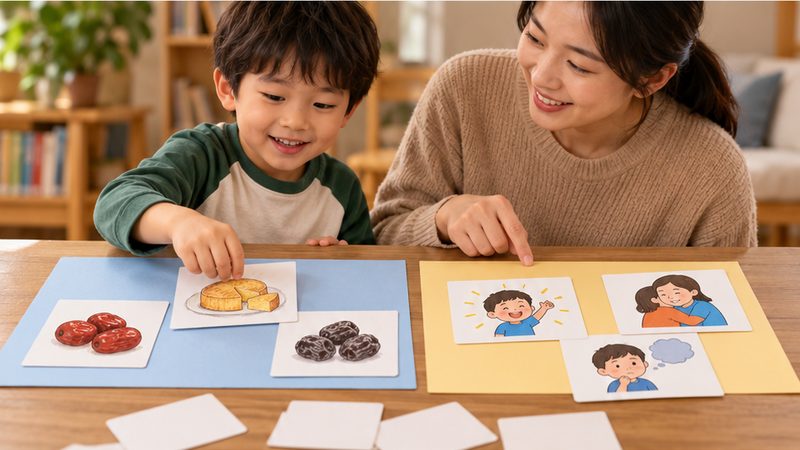
- Show one object. Use a cake drawing, a date, a plum picture, or a story card.
- Say the idiom and pinyin. Let the child repeat it once without forcing memorization.
- Retell the action. Keep the problem, choice, and consequence.
- Name the modern meaning. Use one plain sentence.
- Compare two situations. Choose one fitting example and one near-miss.
- Explain the choice. Ask “Why does this fit?” rather than accepting a guessed label.
Start with one idiom, not all four. A child who can retell one scene, explain one meaning, and reject one near-miss has learned more than a child who can recite four phrases without context. The same method appears in our good Chinese idioms for kids lesson and the broader Chinese idioms for kids guide.
Questions about Chinese food idioms for kids
Are Chinese food idioms really about eating?
Sometimes the literal scene involves eating, but the modern meaning may concern learning, empty promises, imagination, or interest. Teach the literal picture and figurative use as separate layers.
Which food idiom is easiest for a child to learn first?
囫囵吞枣 has a concrete action and a clear study-related comparison, but suitability depends on the child’s age and language level. One well-explained idiom is enough for a first lesson.
Should children memorize the classical source?
Not at first. Beginners can learn the characters, pinyin, source attribution, core story, meaning, and one context check. Older learners can read the original passage with support.
Can I use these idioms to criticize a person?
Use care. An idiom may sound mocking or harsh when aimed directly at someone. Start with fictional situations and discuss the action rather than labeling a child.
Sources and teaching boundary
- Ministry of Education Dictionary: 画饼充饥
- Ministry of Education Dictionary: 囫囵吞枣
- Ministry of Education Dictionary: 望梅止渴
- Ministry of Education Dictionary: 津津有味
Editorial boundary: The historical scenes are source-attributed traditional accounts. The English explanations, examples, and activities are teaching aids rather than one-for-one translations or historical evidence.