Quick answer
Good Chinese idiom stories for preschoolers have visible actions, a small number of characters, and one consequence a child can retell. Start with the picture and story, then say the four-character idiom. The goal is recognition and simple retelling, not memorizing a classical source.
Four useful choices are 畫蛇添足 / 画蛇添足 (huà shé tiān zú), 守株待兔 (shǒu zhū dài tù), 揠苗助長 / 揠苗助长 (yà miáo zhù zhǎng), and 井底之蛙 (jǐng dǐ zhī wā). Each has a concrete image—a snake, rabbit, seedlings, or frog—but each idiom carries a broader meaning that adults should state accurately.
What makes an idiom story work for preschoolers
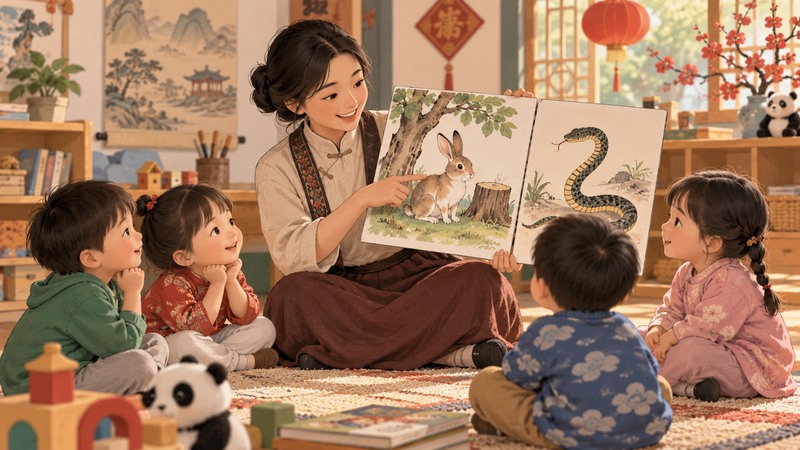
Preschool storytelling works best when the adult shortens the plot without changing the core event. Keep names and political background for later unless the child asks. Repeat the key objects, pause before the consequence, and ask the child what might happen next.
| Idiom | Tone-marked pinyin | Literal picture | Core meaning |
|---|---|---|---|
| 畫蛇添足 / 画蛇添足 | huà shé tiān zú | Add feet to a finished snake drawing | Add something unnecessary and make the result worse |
| 守株待兔 | shǒu zhū dài tù | Wait by a tree stump for another rabbit | Rely on luck or an old method instead of acting and adapting |
| 揠苗助長 / 揠苗助长 | yà miáo zhù zhǎng | Pull seedlings upward to help them grow | Force progress so quickly that the effort causes harm |
| 井底之蛙 | jǐng dǐ zhī wā | A frog sees only the sky above its well | Have a narrow view because one has seen too little |
The meanings and readings above follow entries in Taiwan’s Ministry of Education idiom dictionary. The short versions below are preschool adaptations, not quotations or full translations of the source texts.
Four stories to tell
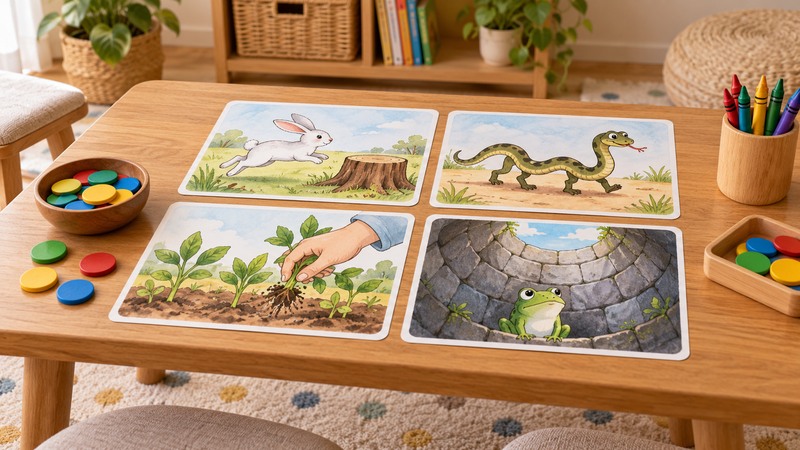
1. 畫蛇添足 / 画蛇添足 — huà shé tiān zú
A child-friendly retelling: Several people decide to draw snakes. One person finishes first. Instead of stopping, he says, “I have time to add feet.” While he draws the extra feet, another person finishes a normal snake. A snake does not need feet, so the first person loses what he had already won.
Meaning to say aloud: “He added something the picture did not need, and it made the result worse.”
Ask: “When was the snake finished? What should the artist have done?”
The Ministry of Education entry gives the reading huà shé tiān zú, traces the story to the *Strategies of the Warring States* (《戰國策》), and defines it as adding an unnecessary act that spoils the result. The detailed Hua She Tian Zu meaning guide can support an adult’s follow-up.
2. 守株待兔 — shǒu zhū dài tù
A child-friendly retelling: A farmer sees a rabbit run into a tree stump. He gets the rabbit by chance. The next day he stops working and waits beside the stump. He hopes another rabbit will do the same thing, but waiting does not make yesterday’s luck happen again.
Meaning to say aloud: “One lucky event is not a plan. We still need to do the work and notice when things change.”
Ask: “Did the farmer make the first rabbit hit the stump? What job did he stop doing?”
The verified reading is shǒu zhū dài tù. The Ministry of Education dictionary traces it to *Han Feizi* (《韓非子》) and explains that it can criticize clinging to an old method or hoping to gain without effort. See Shou Zhu Dai Tu meaning for the full origin and modern usage.
3. 揠苗助長 / 揠苗助长 — yà miáo zhù zhǎng
A child-friendly retelling: A farmer worries that his seedlings are growing too slowly. He pulls every plant upward to make it taller. When his family looks at the field, the damaged seedlings have wilted. Growing needed time; pulling was not real help.
Meaning to say aloud: “Trying to make progress happen too fast can hurt the thing we want to help.”
Ask: “What did the seedlings really need? How could the farmer care for them without pulling?”
The first character is 揠, pronounced yà, meaning to pull up. Do not silently replace the verified idiom with an unrelated same-sound character. The Ministry of Education entry traces the story to *Mencius* (《孟子.公孫丑上》) and defines it as using the wrong method to seek quick results, causing harm instead.
4. 井底之蛙 — jǐng dǐ zhī wā
A child-friendly retelling: A frog lives at the bottom of a well. When the frog looks up, it sees only a small circle of sky. The frog thinks that circle is the whole sky because it has never seen the wide world outside.
Meaning to say aloud: “If we have seen only a little, we should stay curious about what we do not know.”
Ask: “Was the sky really small, or was the frog’s view small? What might the frog discover outside?”
The reading is jǐng dǐ zhī wā. The Ministry of Education dictionary links the expression to the “Autumn Floods” chapter of *Zhuangzi* (《莊子.秋水》) and uses it for someone with limited knowledge or experience. The Jing Di Zhi Wa meaning guide explains common misreadings.
A five-minute story routine
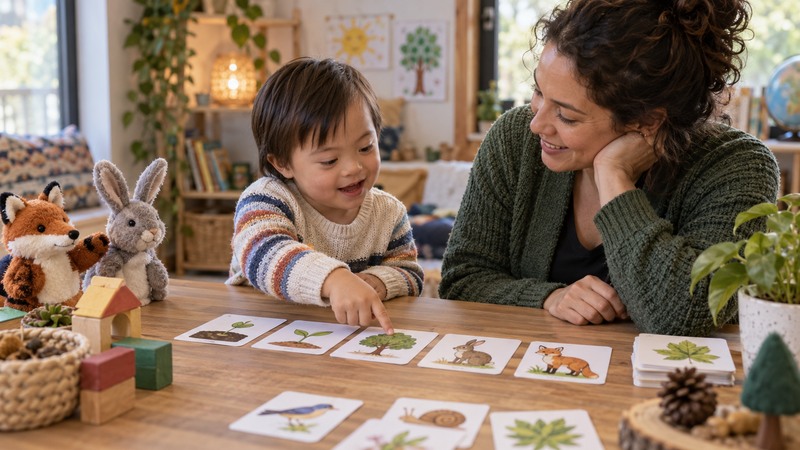
Use the same short routine each time so attention stays on the story rather than new instructions:
- Show one picture. Ask the child to name the animal, plant, or object.
- Tell the story in four or five sentences. Repeat the key action once.
- Pause before the result. Ask what the child thinks will happen.
- Say the idiom slowly. Clap once for each syllable, then repeat the complete pinyin naturally.
- Retell with pictures. Let the child place two to four pictures in story order.
Do not correct every sound while the child is still telling the story. First confirm the sequence and idea. Then model one accurate pronunciation and invite one relaxed repetition. Tone-marked pinyin is a guide for the adult; it should not turn story time into a test.
Keep the lesson accurate and age-appropriate
The ancient sources are not preschool scripts. Adults can preserve accuracy by separating three layers:
| Layer | What to include now | What can wait |
|---|---|---|
| Story event | The visible action and consequence | Political persuasion, authorship debates, or full classical passages |
| Idiom form | Characters and accurate pinyin | Handwriting drills for a child who is not ready |
| Modern meaning | One plain-language sentence | Several abstract example sentences at once |
Avoid turning the moral into a label for the child. Say “This choice was like 守株待兔” instead of calling a child lazy. Say “Let’s not rush this like 揠苗助長” instead of using the story to shame slow learning. The idiom should help name a situation, not become a nickname.
Simple follow-up activities
- Find the extra part: draw a simple animal and let the child point to an added feature that does not belong.
- Work or wait: sort pictures into actions the farmer can take and things that depend only on luck.
- Help a plant: choose watering, sunlight, time, or pulling, then explain which actions help.
- Big view, small view: look through a paper tube and then around the room to compare a narrow view with a wider one.
- Match picture to idiom: use only two cards at first, then add the others when the child can explain the difference.
These activities check understanding through actions and pictures. They do not require a purchased workbook or a promised download.
Frequently asked questions
How many idioms should I teach at one time?
One story is enough for a first session. Add another only when the child can identify the first story’s main action and consequence. The four stories on this page can be spread across several days.
Should preschoolers memorize Chinese characters?
They can notice the four-character shape and recognize a repeated title, but memorization is not required for understanding the story. Match the activity to the child’s language and early-literacy experience.
Should I use simplified or traditional characters?
Use the script followed by the child’s home or school program. This page shows both forms where they differ: 畫/画 and 長/长. The pinyin and core meaning remain the same.
Are these exact translations of the ancient stories?
No. They are short preschool retellings that preserve the central event and consequence. The source notes identify where the idioms are traditionally traced, while the linked dictionary entries provide fuller explanations.
How do I know whether a child understood the idiom?
Ask the child to order pictures, finish the consequence, or choose which of two new situations resembles the story. A useful answer shows the relationship between action and result, even if the child does not recite a dictionary definition.