If you’re searching for chinese idioms with stories, you’re on the right path to mastering Mandarin and Chinese culture. Chengyu (Chinese idioms) are 4-character phrases packed with history, wisdom, and vivid storytelling—each one comes with a unique ancient tale that brings its meaning to life. This guide breaks down what chengyu are, why their stories matter, and shares 5 classic chinese idioms with stories to help you learn naturally.
Quick Answer: Why Learn Chinese Idiom Stories?
Chinese idiom stories help learners understand chengyu because the story explains why the short phrase means more than its literal words. A good story page should show the idiom, pinyin, literal image, English meaning, and a simple modern use case.
Basic Facts for This Search
| Topic | Chinese idiom stories and chengyu learning |
| Best reader | Beginners, parents, teachers, and culture learners |
| Core value | Story plus meaning makes the idiom easier to remember |
| Useful page feature | Pinyin, literal image, plain English meaning, and example use |
What a Good Chengyu Story Page Should Include
A useful chengyu story page should not only retell an old anecdote. It should help the reader move from story to meaning. That means showing the Chinese characters, pinyin, literal image, plain English meaning, and one modern situation where the phrase makes sense.
This structure is especially important for children and beginners. Without the story, a chengyu can feel like a strange four-word translation. With the story, the phrase becomes a compact picture: a person waits by a stump, adds feet to a snake, gives up halfway, or keeps studying despite difficulty.
Use this hub together with focused pages such as Chinese four-character idioms, Chinese idiom stories collection, Chinese chengyu stories.
How to use this page
Use this page as a hub for Chinese idiom stories. Start with one story, read the pinyin and literal image, then move to the meaning and one modern example. Chinese idiom stories are most useful when the story explains why the short chengyu carries a larger lesson.
For beginners, Chinese idiom stories should answer a predictable set of questions: what happened, which phrase came from the story, what the phrase means in English, and when someone might use it today. Without that bridge, Chinese idiom stories can feel like disconnected anecdotes.
Parents and teachers can use Chinese idiom stories as short reading units. Pick one story, ask the learner to retell it, then compare the idiom with a simple daily situation. Chinese idiom stories work better this way than as a memorized vocabulary list.
If you are scanning many Chinese idiom stories, sort them by lesson: patience, cleverness, overdoing, persistence, humility, or warning. This makes Chinese idiom stories easier to review and helps readers choose the right story page for the question they actually have.
When choosing from many Chinese idiom stories, start with the reader’s question instead of the oldest or most famous tale. Chinese idiom stories about patience fit study routines, Chinese idiom stories about overdoing fit editing and planning, and Chinese idiom stories about cleverness fit problem solving. This makes Chinese idiom stories easier to browse because each story has a clear learning job.
Frequently Asked Questions
What is a Chinese idiom story?
It is a short story or historical anecdote that explains the meaning behind a chengyu or fixed Chinese expression.
Why do chengyu need stories?
The story gives context, imagery, and moral meaning that a literal English translation often misses.
Are these stories useful for kids?
Yes, if each story is paired with a simple meaning, pinyin, and a practical example sentence.
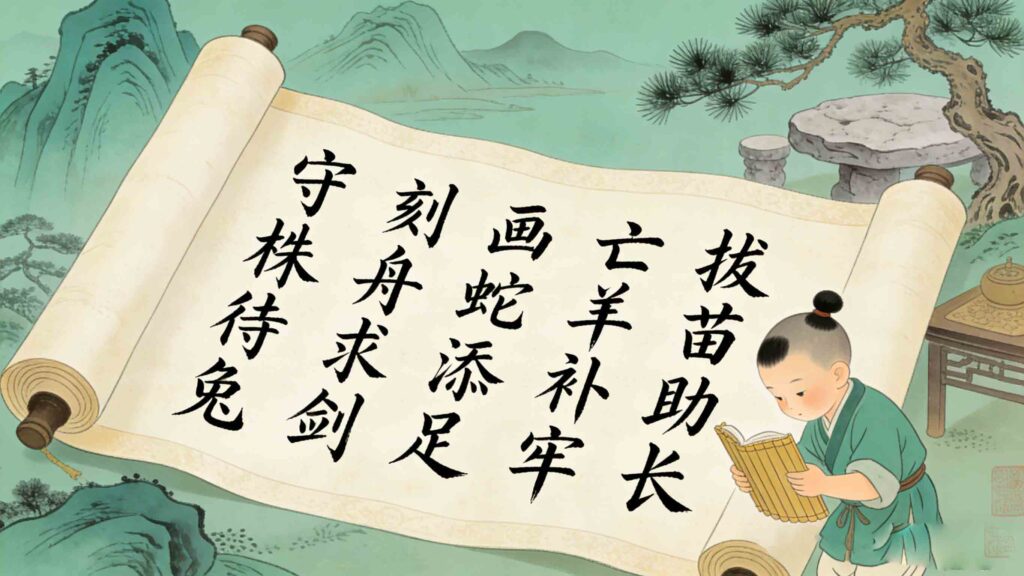
What Are Chinese Idioms (Chengyu)?
Chinese idioms, or chengyu, are a core part of the Chinese language.
Most are 4 characters long, rooted in ancient history, legends, or literature.
Unlike English idioms, every chengyu has a clear origin story.
These stories explain the idiom’s meaning, making them easy to remember and use.
Learning chinese idioms with stories is the best way to understand their cultural context.
Why Learn Chinese Idioms with Stories?
Learning chengyu through their stories offers huge benefits:
- Boost vocabulary: Master 4-character phrases used in daily speech and writing.
- Understand culture: Connect with 2,000+ years of Chinese history and values.
- Improve fluency: Use idioms to sound more natural in conversations.
- Remember easily: Stories make abstract meanings stick far better than rote memorization.
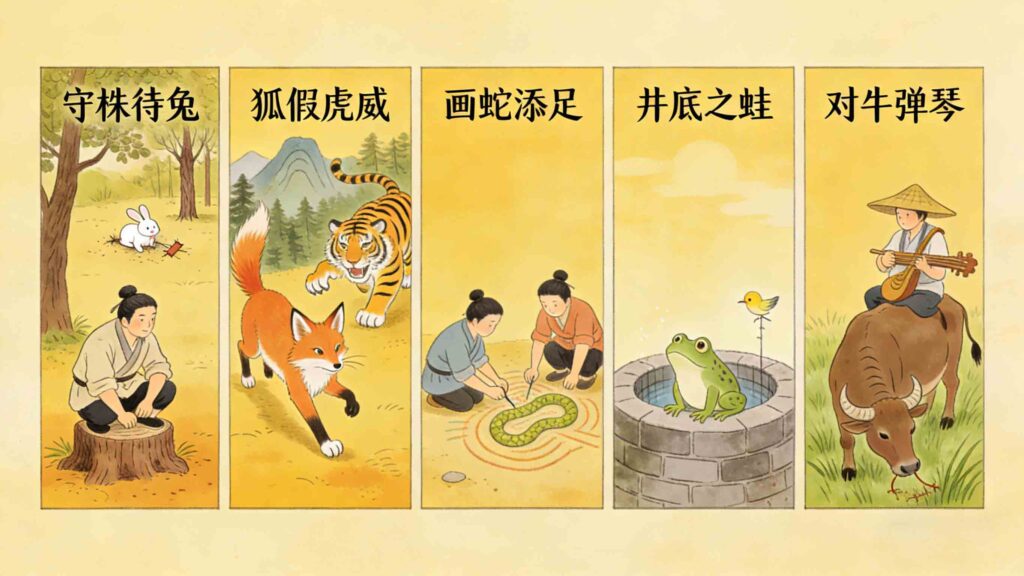
5 Classic Chinese Idioms with Stories
Here are 5 popular chinese idioms with stories, complete with meanings, pinyin, and tales:
Want these idiom stories as a printable sample?
Use the story below for reading practice, then download a free printable animal idiom sample with two bilingual chengyu stories, activities, and answer key.
1. 守株待兔 (Shǒu Zhū Dài Tù) – Waiting for a Hare by the Stump
Pinyin: shǒu zhū dài tù
Meaning: To rely on luck instead of hard work; to wait for an opportunity without effort.
The Story:
A farmer found a hare that ran into a tree stump and died.
He stopped working, waiting by the stump for more hares to hit it.
He never got another hare, and his fields grew wild.
This idiom warns against being lazy and relying on luck.
2. 狐假虎威 (Hú Jiǎ Hǔ Wēi) – The Fox Borrows the Tiger’s Might
Pinyin: hú jiǎ hǔ wēi
Meaning: To bully others by leveraging someone else’s power; to use a powerful connection to intimidate.
The Story:
A fox tricked a tiger into following it.
Other animals ran away, scared of the tiger, not the fox.
The fox claimed the animals feared it, not the tiger.
This idiom describes people who use others’ power to look strong.
3. 画蛇添足 (Huà Shé Tiān Zú) – Drawing Feet on a Snake
Pinyin: huà shé tiān zú
Meaning: To ruin something by adding unnecessary extras; to overdo it.
The Story:
A man won a wine pot by drawing a snake first.
He added feet to the snake to show off, making it no longer a snake.
He lost the wine pot to another man.
This idiom teaches that extra actions can destroy a good result.
4. 井底之蛙 (Jǐng Dǐ Zhī Wā) – The Frog at the Bottom of the Well
Pinyin: jǐng dǐ zhī wā
Meaning: A person with a narrow view of the world; someone who knows nothing outside their small experience.
The Story:
A frog in a well thought the sky was only as big as the well opening.
It laughed at a sea turtle who talked about the vast ocean.
The frog realized how small its world was.
This idiom reminds people to stay humble and learn more.
5. 对牛弹琴 (Duì Niú Tán Qín) – Playing the Harp to a Cow
Pinyin: duì niú tán qín
Meaning: To speak to someone who doesn’t understand; to waste effort on an unresponsive audience.
The Story:
A musician played beautiful music to a cow.
The cow ignored it, only eating grass.
The musician realized the cow couldn’t appreciate the music.
This idiom describes talking to someone who can’t understand your words.
How to Use These Chinese Idioms in Daily Life
Once you learn chinese idioms with stories, you can use them naturally:
- Use them in conversations to add depth and cultural flair.
- Add them to essays or writing to show advanced Mandarin skills.
- Share the stories with others to teach Chinese culture.
- Remember the story first—it will help you recall the idiom’s meaning instantly.

Final Thoughts on Chinese Idioms with Stories
Chinese idioms with stories are more than just phrases—they’re windows into Chinese history, wisdom, and culture.
Each chengyu’s tale teaches a lesson, making them fun and meaningful to learn.
Whether you’re a beginner or advanced learner, mastering these idioms will boost your Mandarin and connect you to Chinese culture.
Download a printable idiom story sample
Keep learning with a free 2-story animal idiom sample PDF. It includes bilingual stories, Pinyin, English meaning, practice activities, and answer key.
Related Resources
Explore more curated chengyu collections to deepen your learning:
Our premium 15 Classic Chinese Idiom Stories for Children resource pack, perfect for young learners.
The 10 Popular Animal-Based Chinese Idioms guide, with fun tales for all ages.
For more linguistic details on chengyu, visit the Wikipedia page for Chinese idioms.