Chinese idioms (chengyu) are the heart of traditional Chinese culture, packed with stories and wisdom passed down for thousands of years. Learning Chinese idioms in English helps you connect with native speakers, understand cultural nuances, and express ideas more vividly. Whether you’re a beginner or an advanced learner, this guide will break down how to use and appreciate these timeless phrases.
If you searched for Chinese idioms, this page is a practical English guide to chengyu meanings, literal translations, story context, and simple examples. You can also explore four-character Chinese idioms, Chinese idiom stories, and famous Chinese idioms after this overview.
Quick Answer
Chinese idioms, or chengyu, are fixed expressions whose meaning often depends on a story or cultural reference. An English explanation is most useful when it gives the characters, pinyin, literal image, intended meaning, and one natural example.
At a Glance
| Chinese term | 成语, chéngyǔ |
|---|---|
| This page | Meaning, story context, and sample usage |
| Not the same as | A ranked common list or a sentence workbook |
Quick reference: read the English equivalent as a usage clue, not always as a word-for-word translation.
What Are Chinese Idioms in English?
Chinese idioms are short, fixed phrases—usually four characters long—with meanings that go beyond their literal translation. When we talk about Chinese idioms in English, we’re referring to their translated explanations, story contexts, and usage examples that make them accessible to English speakers.
Unlike proverbs in other languages, Chinese idioms often come from historical events, fables, or classic texts. Learning them isn’t just about vocabulary—it’s about unlocking the stories behind the words.
Popular Chinese Idioms in English & Their Stories
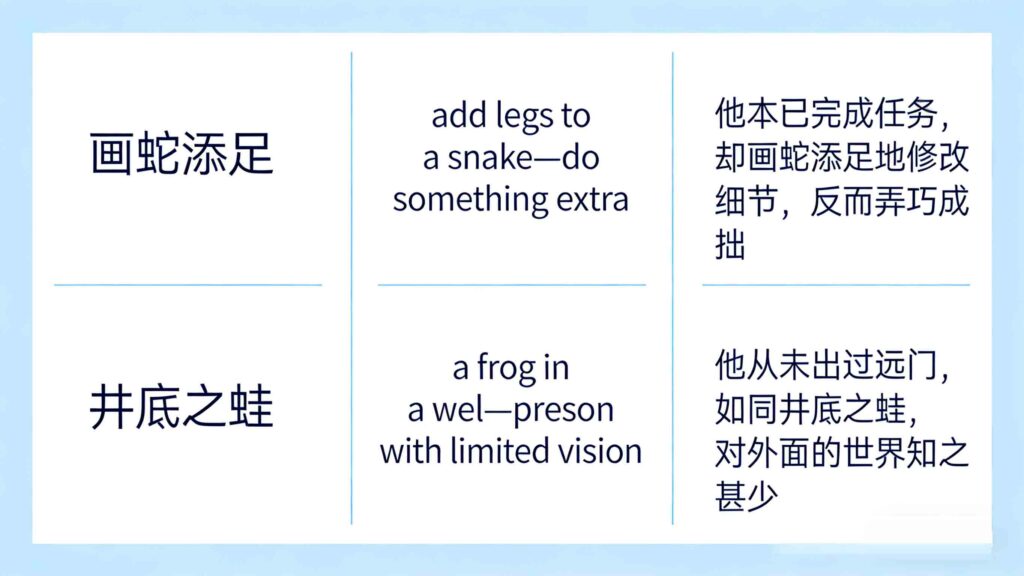
Let’s explore some widely used Chinese idioms in English, with clear meanings and the tales that inspired them.
1. 一马当先 (Yī Mǎ Dāng Xiān)
- English meaning: To take the lead; to be the first to act.
- Story: This idiom comes from ancient battlefields, where the leading horse would charge ahead of the army. Today, it describes someone who takes initiative and guides others.
- Example: She always takes the lead in team projects, just like the leading horse in a race.
2. 马到成功 (Mǎ Dào Chéng Gōng)
- English meaning: Instant success; to achieve victory quickly.
- Story: Soldiers used this phrase to wish each other luck before battles, as horses were seen as a symbol of speed and victory. Now it’s a common greeting for exams or new projects.
- Example: We wish you immediate success in your new job—may you achieve it as quickly as a horse arriving at the battlefield.
3. 汗马功劳 (Hàn Mǎ Gōng Láo)
- English meaning: Great contributions made through hard work.
- Story: It refers to the sweat and effort of war horses, symbolizing the tireless work of soldiers or contributors to a cause.
- Example: His years of hard work have earned him great credit in the company.
4. 走马观花 (Zǒu Mǎ Guān Huā)
- English meaning: To glance at things briefly; to skim the surface.
- Story: A poet once viewed flowers while riding a fast horse, only catching a quick glimpse. It warns against superficial observation.
- Example: A quick tour of the museum is just a superficial look—you can’t truly appreciate the art in such a short time.

How to Read an English Explanation of a Chengyu
A useful English entry normally has several layers. The Chinese characters identify the fixed expression, pinyin shows pronunciation, and the literal translation preserves the image. The natural English meaning then explains the situation in which a speaker would choose the idiom. These layers should support one another, but they do not serve the same purpose.
Literal Image Versus Intended Meaning
Literal wording is memorable, but it can be misleading when read alone. “Looking at flowers from horseback,” for example, creates a clear picture, yet the idiom 走马观花 is used for a quick or superficial look. A translation that gives only the horse and flowers has not finished the explanation.
The reverse problem also occurs. An English equivalent may communicate the intended meaning but hide the Chinese image and story. That is useful for immediate understanding, but learners still need the original image if they want to recognize the phrase later or understand why it carries a particular tone.
Check Tone and Subject
Two idioms can share a rough English gloss while differing in judgment. One may praise effort, another may criticize narrow thinking, and a third may work mainly as a congratulatory wish. Before copying an example, identify who or what the idiom describes and whether the sentence sounds approving, neutral, humorous, or critical.
Use the Story as a Boundary, Not Decoration
The source story is most valuable when it explains the usage boundary. It should answer why the phrase means what it means and which situations are comparable. A long historical retelling that never connects back to modern usage is less useful than a short source note followed by a precise example.
When comparing references, prefer an entry that separates these elements clearly. That structure helps you move from recognition to correct use without assuming that every English phrase has a one-to-one Chinese equivalent.
How to Learn Chinese Idioms in English Effectively
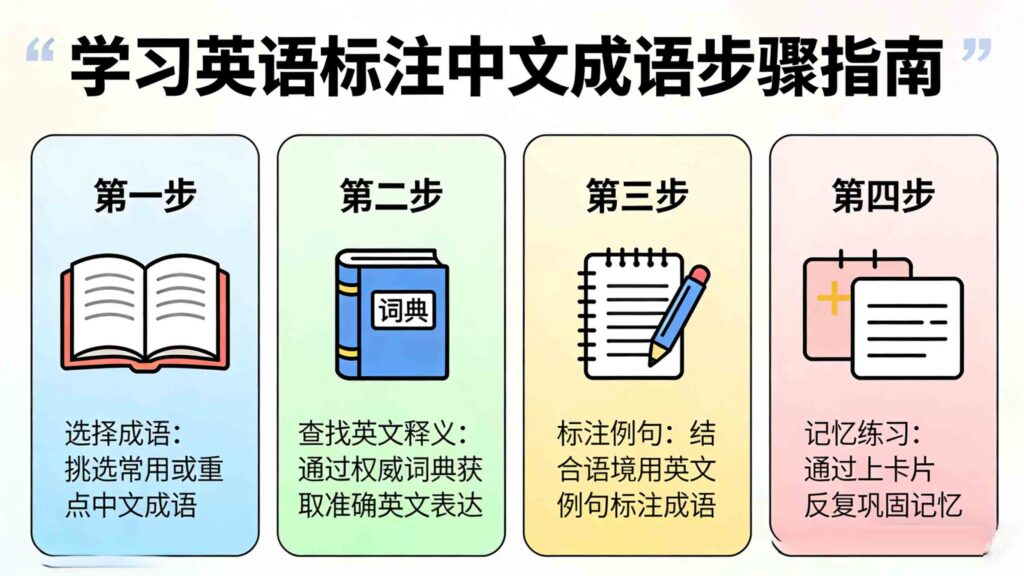
Learning Chinese idioms in English doesn’t have to be overwhelming. Follow these simple steps to build your vocabulary and use them naturally:
- Start with common idioms: Focus on 5-10 high-frequency phrases first, like the ones above, to build confidence.
- Learn the story: Understanding the origin of an idiom helps you remember its meaning and use it correctly.
- Practice in context: Write short sentences or dialogues using the idioms to reinforce your learning.
- Listen and repeat: Use audio resources to hear native speakers pronounce the idioms, then try using them in conversations.
Why Chinese Idioms in English Matter for Learners
Mastering Chinese idioms in English offers several key benefits:
- Cultural insight: Idioms reveal Chinese values like hard work, perseverance, and respect for history.
- Better communication: Using idioms makes your speech and writing more vivid and natural, helping you connect with native speakers.
- Exam preparation: Many Chinese language tests (like HSK) include idioms, so knowing them boosts your score.
- Business use: Idioms are common in professional settings, showing cultural awareness and fluency.
Final Thoughts
Chinese idioms in English are more than just words—they’re a window into Chinese culture and a powerful tool for language learning. By learning their stories and practicing their usage, you’ll not only expand your vocabulary but also deepen your understanding of the people and traditions behind the language.
Whether you’re learning Chinese for travel, study, or work, taking the time to master these idioms will make your journey more rewarding.
If you love classic stories for kids, check out our 15 Kids Chinese Idiom Stories Pack—a fun, illustrated resource to introduce children to chengyu.
For tales of hard work and perseverance, explore our 10 Diligence Stories Pack—featuring inspiring idioms about effort and success.
For more background on Chinese idiom origins, you can refer to the Wikipedia entry on Chinese Chengyu.
One Idiom Can Need Several English Explanations
An idiom does not always map to one fixed English phrase. A wish for immediate success can require different wording for a new job, an exam, a project, or a journey. A dictionary equivalent is a guide to meaning rather than a replacement that can be pasted into every sentence.
Compare the tone and grammar of possible English equivalents. Choose the version that matches the speaker’s purpose, then return to the Chinese example to confirm that the subject and situation are comparable. This prevents a translation from being understandable but pragmatically awkward.
For study notes, record one literal image, one plain-English definition, and two short examples with different contexts. That gives the idiom useful range without suggesting that it means everything related to the same theme.
A final context check is useful: ask whether the English wording describes the same action, emotion, and outcome as the original idiom. If one of those changes, explain the difference instead of presenting the phrases as exact equivalents. This makes the entry more reliable for both reading and writing practice.
Frequently Asked Questions About Chinese Idioms in English
What are Chinese idioms? Chinese idioms, or chengyu, are short fixed expressions, often four characters long, that carry a story, cultural meaning, or lesson beyond the literal words.
What does chengyu mean in English? Chengyu is usually translated as Chinese idiom. A useful English explanation should include the literal meaning, the story behind it, and a modern usage example.
How should beginners learn Chinese idioms? Start with common idioms, read the story, learn the English meaning, then practice one short example sentence before moving to a longer list.