Chinese idioms in essays are a powerful way to elevate your academic and creative writing.
Chinese idioms in essays (chéngyǔ) are not just decorative flourishes—they are powerful tools that can transform your writing.
These idioms add layers of meaning, vivid imagery, and authoritative insight to your arguments.
Whether you’re crafting a literary analysis, a persuasive argument, or a personal reflection, integrating Chinese idioms in essays can help you convey complex ideas with elegance.
engage your readers, and set your work apart.
This article explores the most practical and widely used Chinese idioms in essays, their meanings, and how to apply them to elevate your academic writing.
Quick Answer: Which Chinese Idioms Work in Essays?
Useful Chinese idioms for essays are phrases whose meaning and tone fit a specific sentence. This guide groups nine chengyu for argumentative, descriptive, narrative, reflective, and analytical writing, with pinyin and example sentences. For Chinese composition phrases, accuracy matters more than inserting as many idioms as possible.
Basic Facts
| Page scope | Nine chengyu for three essay purposes |
|---|---|
| Each entry includes | Pinyin, literal meaning, application, and example |
| Best practice | Choose one idiom that precisely matches the claim |
| Common mistake | Using a literal translation without checking modern context |
Quick reference: explain an unfamiliar chengyu the first time it appears, especially when the essay is written for readers who may not know Chinese.
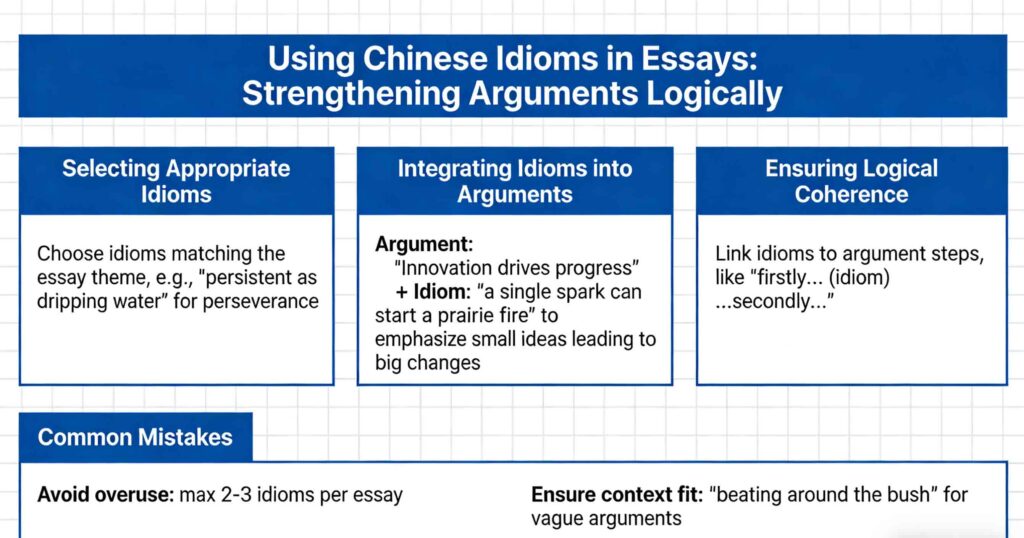
Why Chinese Idioms in Essays Are a Powerful Tool
Chinese idioms in essays are deeply rooted in Chinese history, literature, and philosophy, distilling millennia of wisdom into concise, memorable phrases. When used thoughtfully, they can:
·Enhance the rhetorical impact of your arguments, making your points more memorable and persuasive.
·Add vivid imagery and emotional depth to your prose, creating a more engaging reading experience.
·Infuse your writing with cultural richness and authority, positioning you as a thoughtful and well-read writer.
·Improve the flow and rhythm of your sentences, making your essay more polished and professional.
For students and writers alike, Chinese idioms in essays are not just a nice-to-have—they are an essential part of crafting compelling, sophisticated academic work. Below are the most essential idioms, categorized by common essay types to make them easy to apply.
Chinese Idioms in Essays for Argumentative Writing
Argumentative essays require you to take a clear stance and support it with evidence and logic. Chinese idioms in essays can help you strengthen your arguments, make your points more memorable, and persuade your readers.
1. Yī zhēn jiàn xiě (一针见血) – Get Straight to the Point
Pinyin: Yī zhēn jiàn xiě
Literal Meaning: One needle draws blood.
Essay Application: This idiom is perfect for emphasizing clarity and precision in your arguments, cutting through the noise to address the core issue.
Example: “The author’s critique of modern consumerism is yī yī jiàn xuè, exposing the emptiness of materialism with unflinching honesty.”
2. Tiān yī wú fèng (天衣无缝) – Seamless as the Robes of Heaven
Pinyin: Tiān yī wú fèng
Literal Meaning: The robes of heaven have no seams.
Essay Application: This idiom describes an argument or narrative that is perfectly constructed, with no logical gaps or inconsistencies.
Example: “Her thesis on climate change policy is tiān yī wú fèng, weaving together data from environmental science, economics, and political theory to support her claims.”
3. Jiān chí bù xiè (坚持不懈) – Persist Without Giving Up
Pinyin: Jiān chí bù xiè
Literal Meaning: Persist without slackening.
Essay Application: This idiom supports a paragraph about sustained effort, especially when an argument depends on long-term research, revision, or commitment.
Example: “The researcher worked jiān chí bù xiè, revising the evidence until the argument was both clear and well supported.”
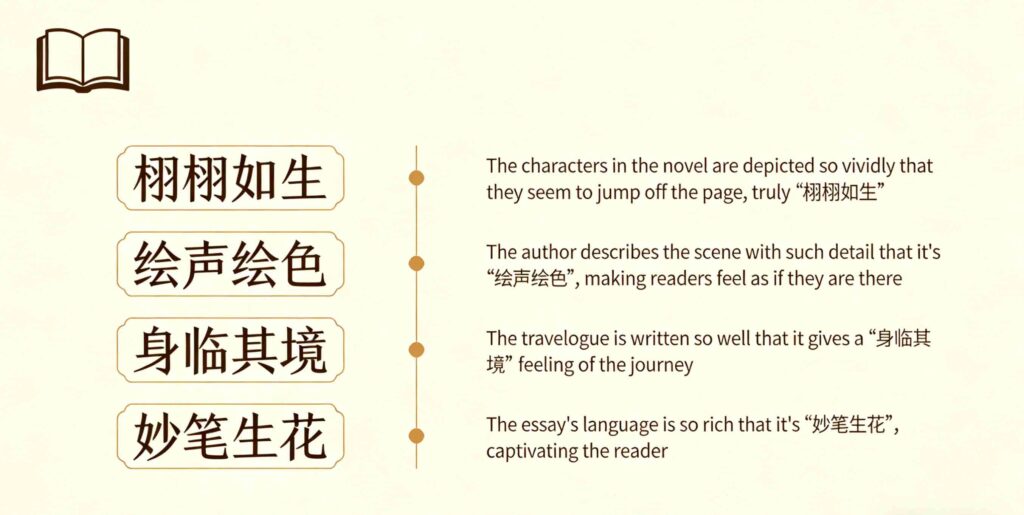
Chinese Idioms in Essays for Descriptive & Narrative Writing
Descriptive and narrative essays aim to paint a picture with words, and Chinese idioms in essays are perfect for this task. These idioms can help you create vivid, sensory scenes that transport your readers to another world.
1. Wàn zǐ qiān hóng (万紫千红) – A Profusion of Colors
Pinyin: Wàn zǐ qiān hóng
Literal Meaning: Ten thousand purples and a thousand reds.
Essay Application: This idiom vividly describes a scene of vibrant colors, often used to depict spring, a festival, or a moment of intense emotion.
Example: “The carnival came alive in wàn zǐ qiān hóng, with dancers in silk costumes, firecrackers exploding in the sky, and the sweet scent of jasmine filling the air.”
2. Rú shī rú huà (如诗如画) – As Poetic as a Painting
Pinyin: Rú shī rú huà
Literal Meaning: Like poetry, like a painting.
Essay Application: This idiom is used to describe a scene of extraordinary beauty, where reality feels like a work of art.
Example: “The mist-shrouded mountains and crystal-clear lake created a rú shī rú huà landscape that inspired the poet’s greatest work.”
3. Yī bō sān zhé (一波三折) – One Wave, Three Twists
Pinyin: Yī bō sān zhé
Literal Meaning: One wave, three twists and turns.
Essay Application: This idiom describes a narrative with many unexpected twists and turns, keeping readers engaged and guessing.
Example: “The memoir was full of yī bō sān zhé, as the author recounted her journey from a small village to the heights of international success.”
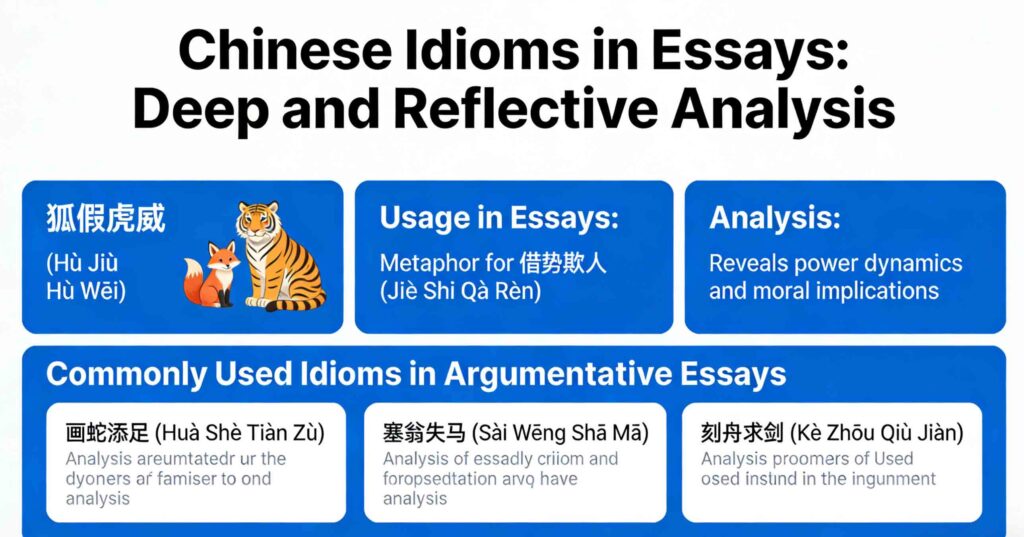
Chinese Idioms in Essays for Reflective & Analytical Writing
Reflective and analytical essays require you to think deeply about a topic and draw meaningful conclusions. Chinese idioms in essays can help you articulate complex insights and convey the depth of your thinking.
1. Jǔ yī fǎn sān (举一反三) – Infer Three Things from One
Pinyin: Jǔ yī fǎn sān
Literal Meaning: Infer three things from one.
Essay Application: This idiom emphasizes the importance of critical thinking and drawing broader conclusions from specific examples.
Example: “By analyzing the protagonist’s choices, we can jǔ yī fǎn sān and draw broader conclusions about the pressures faced by young people in that era.”
2. Bō yún jiàn rì (拨云见日) – Clear the Clouds to See the Sun
Pinyin: Bō yún jiàn rì
Literal Meaning: Push aside the clouds to see the sun.
Essay Application: This idiom describes the moment when confusion is dispelled and clarity is achieved, often used to depict a breakthrough in understanding.
Example: “After months of research, the scholar finally bō yún jiàn rì, uncovering the hidden connections between ancient texts and modern political theory.”
3. Yǐ gǔ wéi jiàn (以古为鉴) – Take the Past as a Mirror
Pinyin: Yǐ gǔ wéi jiàn
Literal Meaning: Take the past as a mirror.
Essay Application: This idiom is used to emphasize the importance of learning from history to understand the present and shape the future.
Example: “By studying the fall of the Roman Empire, we can yǐ gǔ wéi jiàn and avoid repeating the mistakes of the past in our own time.”
Tips for Using Chinese Idioms in Essays Effectively
To make the most of Chinese idioms in essays, keep these tips in mind:
First, understand the context: each idiom has a specific meaning and usage scenario. Make sure it fits the tone and purpose of your essay to avoid miscommunication.
Second, use them sparingly: while idioms are powerful, overusing them can make your writing seem forced or pretentious. Focus on quality over quantity, and only use an idiom when it truly enhances your prose.
Third, consider your audience: if you’re writing for non-Chinese readers, briefly explain the meaning of the idiom to ensure everyone understands. This also adds educational value to your work.
Finally, practice makes perfect: the more you use Chinese idioms in essays, the more natural and intuitive it will become. Start with a few key idioms and gradually expand your repertoire as you gain confidence.
Conclusion: Elevate Your Essays with Chinese Idioms
Chinese idioms in essays are more than just words—they are a window into Chinese culture and a powerful tool for crafting compelling, sophisticated academic writing. Whether you’re writing an argumentative paper, a descriptive narrative, or a reflective analysis, these idioms can help you convey complex ideas with elegance, engage your readers, and set your work apart. By mastering Chinese idioms in essays, you can elevate your writing style and achieve greater success in your academic pursuits.
For authoritative background on the linguistic and cultural roots of these phrases, you can refer to the comprehensive entry on (Chengyu) on Wikipedia.
If you want to master advanced techniques for elevating your academic work, check out our premium guide: Mastering Chengyu for Academic Excellence: Unlock Your Essay Potential.
Chinese Idioms for Essays FAQ
How many Chinese idioms should I use in one essay?
There is no fixed number. One or two well-chosen idioms are usually more effective than several phrases that interrupt the argument or sound forced.
Should I translate a chengyu in an English essay?
Yes, when readers may not know Chinese. Give the pinyin or characters, then explain the intended meaning in the sentence rather than relying only on a literal translation.
What makes a Chinese composition phrase appropriate?
The phrase should match the essay type, tone, and claim. Check its modern usage and avoid adding it only because it sounds formal.