Why Chinese Idioms About Life Resonate
For anyone learning Chinese, Chinese idioms about life are more than just linguistic flourishes.
Quick Answer: What Are Chinese Idioms About Life?
Chinese idioms about life are chengyu or fixed sayings that express lessons about patience, effort, relationships, change, mistakes, and self-control. The best way to learn them is to connect each idiom with a real situation, not only memorize the English translation.
Basic Facts for This Search
| Topic | Chinese idioms about life and daily judgment |
| Reader need | Meaning, pinyin, life lesson, and usable context |
| Best learning method | Match each idiom to one practical situation |
| Common mistake | Reading the English gloss without the story or context |
Start With Life Situations, Not a Long List
A list becomes more useful when the reader knows what kind of life problem each idiom answers. Some phrases warn against impatience. Some praise steady effort. Some describe how relationships change. Others help explain mistakes, timing, or the limits of luck.
For beginners, the first question should be simple: when would a speaker actually use this expression? If the answer is clear, the idiom is easier to remember. If the answer is vague, the page should give a scene, a short explanation, and one plain English paraphrase before asking the learner to memorize anything.
For broader study paths, connect this life-theme page with Chinese four-character idioms, Chinese idiom stories collection, Chinese chengyu stories.
How to use this page
Use this page as a situation map, not only as a list. Chinese idioms about life are easier to remember when each phrase is tied to one everyday problem: impatience, change, mistakes, effort, relationships, timing, or self-control.
Before choosing an idiom, ask what kind of life lesson the sentence needs. If the lesson is about patience, choose a phrase that shows time and persistence. If the lesson is about mistakes, choose a phrase with a clear warning. If the lesson is about relationships, look for an idiom where tone matters and avoid using it as a blunt label.
For beginners, a useful reading routine is meaning, story, situation, and example. First read the plain English meaning. Then check whether there is a short story or cultural image. Next decide when the idiom would naturally appear in daily life. Finally, write one sentence that uses the idea without forcing it into every conversation.
This approach makes life-theme chengyu more practical. The reader is not memorizing decoration; the reader is building a small set of expressions for choices, setbacks, growth, and judgment.
A practical way to review Chinese idioms about life is to group them by the decision they help explain. Some phrases warn against rushing, some describe steady effort, and some remind the reader to judge timing or tone. When readers connect Chinese idioms about life with one clear situation, the phrases become easier to remember and safer to use in writing, teaching, or conversation.
As a final review, choose two Chinese idioms about life and explain the difference in tone. One may sound encouraging, while another may warn against a mistake. That comparison helps readers avoid using a wise-sounding phrase in the wrong moment.
Frequently Asked Questions
What are good Chinese idioms about life for beginners?
Start with idioms that have clear everyday lessons about effort, patience, mistakes, and relationships.
Do Chinese idioms about life always have stories?
Many chengyu have story backgrounds, but some are learned mainly through usage and context.
How can I use these idioms naturally?
Learn the situation first, then practice one short sentence that fits a real life choice or problem.
They are condensed nuggets of wisdom, shaped by thousands of years of culture.
These phrases, known as chengyu, offer profound insights into human nature, relationships, and the ebb and flow of existence.
They are not just for exams or literature.
You can use these everyday Chinese idioms to express complex emotions and ideas in simple, vivid terms.
This makes them perfect for everyday conversation and reflection.

Key life-related chengyu and Their Meanings
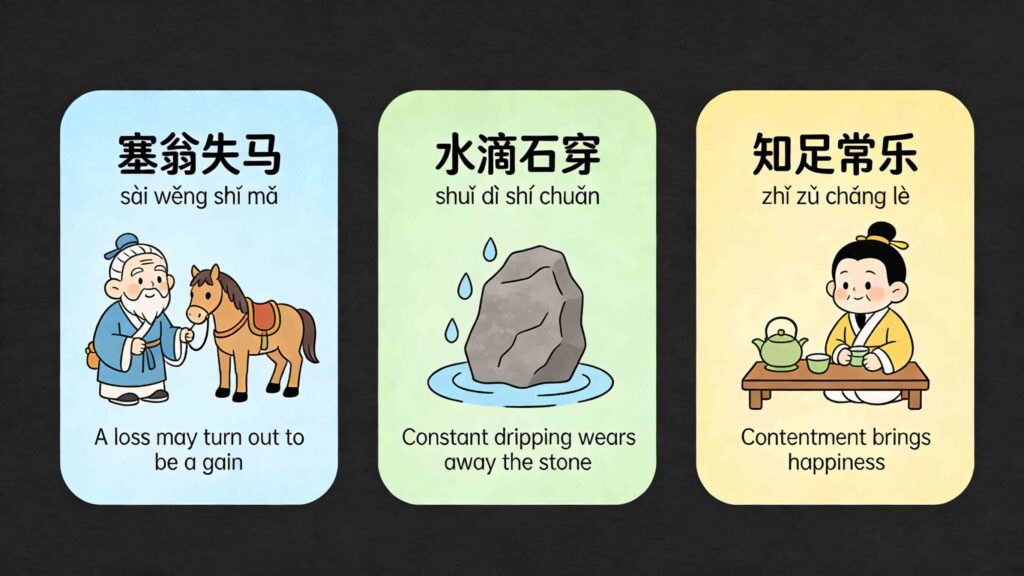
1. 塞翁失马 (Sài Wēng Shī Mǎ)
Meaning: A blessing in disguise; every cloud has a silver lining.
This idiom tells the story of an old man whose horse runs away, only to return with a fine steed later.
It teaches us that misfortune can lead to unexpected good fortune.
“When I missed the bus, I met an old friend. It was a real case of ‘Sài Wēng Shī Mǎ’.”
2. 水滴石穿 (Shuǐ Dī Shí Chuān)
Meaning: Constant dripping wears away the stone; persistence conquers all.
This idiom emphasizes the power of small, consistent efforts over time.
It’s a reminder that great achievements are built through daily dedication.
“Mastering a language is not easy, but ‘Shuǐ Dī Shí Chuān’ keeps me going.”
3. 知足常乐 (Zhī Zú Cháng Lè)
Meaning: Contentment brings happiness; he who is content is always happy.
This idiom encourages us to appreciate what we have rather than endlessly chasing more.
It reflects a core value in traditional Chinese philosophy.
“Instead of worrying about the next promotion, I try to practice ‘Zhī Zú Cháng Lè’ and enjoy the present.”
Applying Chinese Idioms About Life in Modern Contexts
The beauty of Chinese idioms about life is their timeless relevance.
They can be applied to modern challenges, from career setbacks to personal growth.
For example, when facing a difficult decision, you might reflect on “塞翁失马” to stay optimistic.
When working on a long-term project, “水滴石穿” can be your mantra for perseverance.
When feeling overwhelmed by material desires, “知足常乐” can help you find peace.
These phrases are not relics of the past.
They are living tools that can help you navigate the complexities of modern life with greater clarity and resilience.
How to Learn and Use Chinese Idioms About Life
To deepen your understanding of Chinese idioms about life, start with a few key phrases.
Learn their stories and contexts.
Then, practice using them in your own writing and conversations.
You can also explore more resources, like our guide on Everyday Chinese Idioms , to expand your repertoire.
For a deeper dive into the cultural context, check out Chinese Language & Culture resources.

Final Thought
Chinese idioms about life are a window into the heart of Chinese culture.
They offer not just words, but a way of seeing the world.
By embracing these phrases, you can enrich your own life and connect more deeply with the wisdom of the past.