Quick answer: Good Chinese idioms for kids have a concrete scene, one clear decision and a meaning that can be tested against everyday life. Five useful starting points are 守株待兔, 画蛇添足, 亡羊补牢, 刻舟求剑 and 井底之蛙. Each gives a learner something visible to retell before moving to a figurative meaning.
These are not ranked as the “best” idioms for every child. Age, reading level and language background matter. The short retellings below separate the traditional source from a new teaching activity, and the English glosses are reading aids rather than one-for-one translations.
- Learning task
- Retell the action, name the consequence, then test a modern situation.
- Written form
- Simplified characters in the main text; traditional forms are noted.
- Pronunciation
- Mandarin pinyin with tone marks.
- Evidence boundary
- Source traditions and meanings are checked against the Ministry of Education Dictionary of Chinese Idioms; the classroom prompts are original.
Choose an idiom a child can picture and explain
A memorable object is only the entry point. A stump, snake, sheep pen, boat or well helps a child recall the scene, but the learner still needs to explain what the person did and why the result matters. Ask “What changed because of that choice?” before asking for a definition.
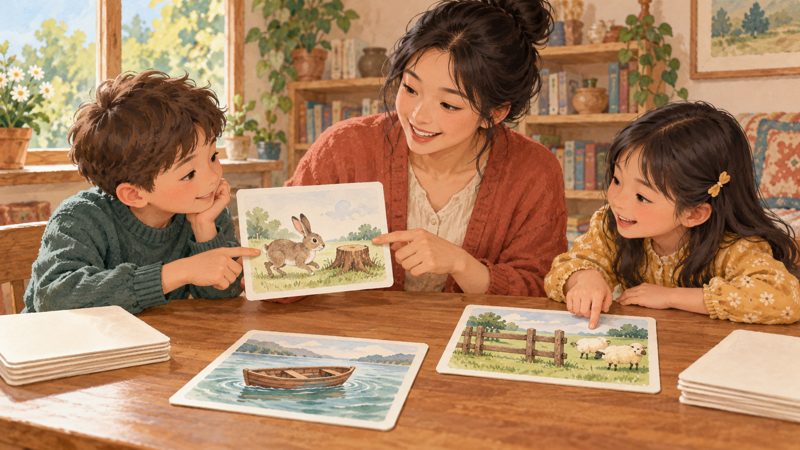
Keep the first activity small. Read one story, cover the text, and retell it in three steps: problem, choice and consequence. Then compare one modern example and one counterexample. That last step prevents a child from applying the idiom to every situation that happens to contain the same animal or object.
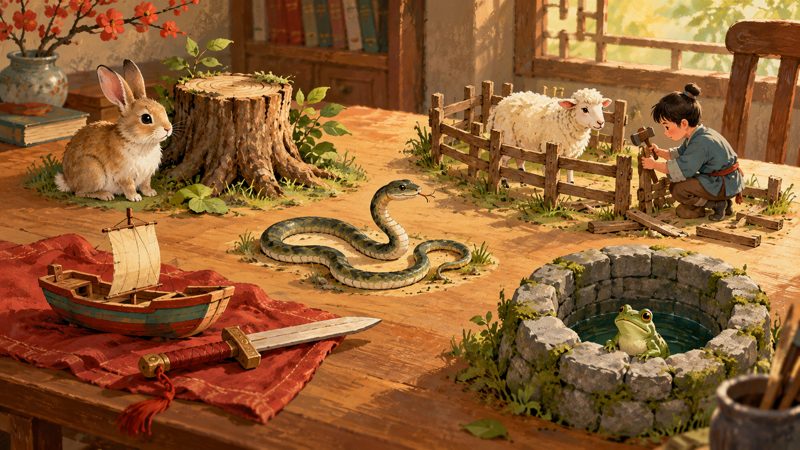
守株待兔: a lucky accident is not a plan
- Read it
- shǒu zhū dài tù · traditional form is the same.
- Literal scene
- Wait beside a tree stump for a rabbit.
- Meaning here
- Rely on an old method or hope that an accidental gain will repeat instead of taking useful action.
A farmer once gets a rabbit after it runs into a tree and dies. He leaves his work and waits by the stump for the same accident to happen again, but no second rabbit arrives. The MOE dictionary entry for 守株待兔 traces the story to Han Feizi, “Wu Du,” and records meanings involving rigid reliance and idle expectation.
Try it: Give two study plans: “review ten words each evening” and “wait for the same easy quiz question.” Ask which plan resembles the farmer and why. A scheduled wait, such as waiting for a bus, is a useful counterexample because no lucky accident is replacing action.
画蛇添足: an extra step can spoil the result
- Read it
- huà shé tiān zú · traditional: 畫蛇添足.
- Literal scene
- Draw a snake and add feet.
- Meaning here
- Add something needless that makes an already sufficient result worse.
In a drawing contest for a wine prize, one person finishes a snake first. Instead of stopping, he adds feet. Another contestant completes a proper snake and takes the prize. The MOE entry for 画蛇添足 identifies Zhan Guo Ce, “Qi Ce II,” as the source and explains the needless addition that reverses the outcome.
Try it: Show a clear invitation with the date and place, then add a paragraph that repeats the same details in confusing language. Ask what became harder to use. Correcting a wrong date is not 画蛇添足; it is a necessary repair.
亡羊补牢: repair the cause after a mistake
- Read it
- wáng yáng bǔ láo · traditional: 亡羊補牢.
- Literal scene
- Repair the sheep pen after losing a sheep.
- Meaning here
- Correct a problem promptly so the same kind of loss is less likely to happen again.
The expression does not pretend that the first loss vanishes. It focuses on what can still be improved. The MOE entry for 亡羊补牢 links it to Zhan Guo Ce, “Chu Ce IV,” and explains the timely-correction meaning.
Try it: A learner forgets homework because it was never written down. The repair is not merely saying “I will remember.” It could be recording the task before leaving class and checking the notebook at home. Ask which action addresses the cause and which only expresses regret.
Boundary: Do not use this idiom to blame a child for every accident. It fits when a useful corrective action remains possible. It does not guarantee that a repair will recover what was already lost.
刻舟求剑: the mark moves, but the sword does not
- Read it
- kè zhōu qiú jiàn · traditional: 刻舟求劍.
- Literal scene
- Mark a moving boat where a sword fell into the water.
- Meaning here
- Use a fixed method while ignoring that the situation has changed.
A traveller drops a sword from a boat and marks the side of the boat. When the boat stops, he searches below the mark, although the boat moved and the sword stayed where it fell. The MOE entry for 刻舟求剑 traces the account to Lu Shi Chun Qiu, “Cha Jin,” and uses it for rigid action that does not adapt to changing conditions.
Try it: Move a pencil while keeping a paper marker in the old place. Ask why the marker no longer locates the pencil. Then compare a study method that worked for five new words but fails when the learner has fifty. The lesson is not that every old method is bad; it is that the method must still match the situation.
井底之蛙: one view is not the whole world
- Read it
- jǐng dǐ zhī wā · traditional form is the same.
- Literal image
- A frog at the bottom of a well.
- Meaning here
- A person whose knowledge is limited by a narrow range of experience.
A frog can see only the small patch of sky above the well and mistakes that limited view for the whole. The MOE entry for 井底之蛙 connects the expression to the discussion of limited perspective in Zhuangzi, “Qiu Shui.”
Try it: Let one learner view only a small crop of a larger picture and make a guess. Reveal the full scene and discuss what information was missing. The point is limited evidence, not calling a person unintelligent. Use the expression carefully because it can sound insulting when aimed directly at someone.
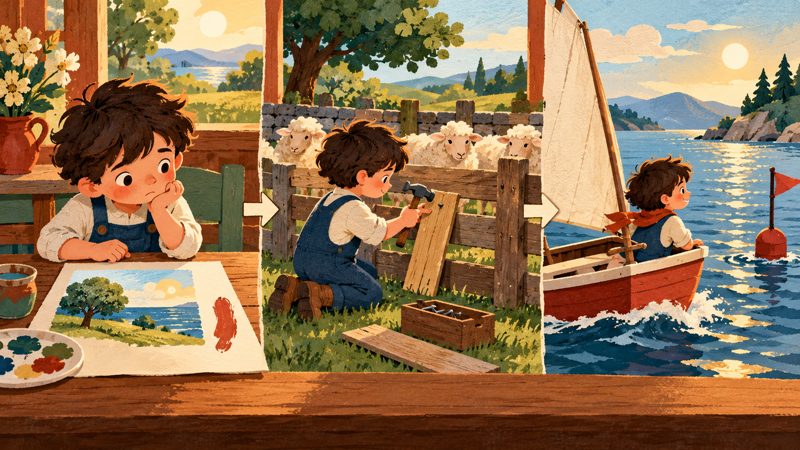
Run one ten-minute story-to-meaning activity
- Pick one idiom. Do not introduce all five in the same first lesson.
- Retell three steps. State the problem, the person’s choice and the consequence.
- Name the meaning. Use plain language before asking for the four-character phrase.
- Test two situations. Choose one fitting example and one near-miss.
- Make one sentence. Let the learner explain why the idiom fits rather than only inserting it into a blank.
To check how traditional stories and later meanings should be separated, see Chinese idioms from history.
Questions about Chinese idioms for kids
What makes a Chinese idiom suitable for a child’s first lesson?
A concrete scene, a short chain of events and a meaning that can be compared with familiar choices make an idiom easier to discuss. Suitability still depends on the child’s age, language level and the adult’s explanation.
Should children memorize the full classical source?
Not necessarily. A beginner can first learn the modern expression, pinyin, core meaning and source attribution. Older or more advanced learners can read the original passage with appropriate support.
Are the five stories verified historical events?
No. They are traditional accounts attributed to named texts in the dictionary sources. The article does not present the scenes as independently verified history.
Can a picture alone teach the meaning?
No. A picture helps recall objects and actions, but the learner still needs the consequence, figurative meaning and a context check. Ask why the idiom fits and when it would not fit.