Wang Mei Zhi Ke (望梅止渴) means comforting yourself with an imagined satisfaction when the thing you want is not available. Its literal image is quenching thirst by thinking of plums. It does not mean worrying that the sky will fall.
Wang Mei Zhi Ke Meaning: Quick Answer
Use 望梅止渴 when a thought, picture, or promise offers temporary consolation but does not fulfill the underlying wish. For example, looking at holiday photographs when you cannot take a trip can be a way of 望梅止渴.
Basic Facts
| Pinyin | wàng méi zhǐ kě |
|---|---|
| Literal image | Looking toward plums to relieve thirst |
| Story setting | Cao Cao’s thirsty soldiers in a transmitted literary anecdote |
| Modern use | Imaginary satisfaction or consolation, rather than actual fulfillment |
| Sentence fit | Someone substitutes a thought or picture for an unavailable experience |
| Source boundary | Shishuo Xinyu, Jia Jue; the passage does not specify a campaign date or location |
The Cao Cao plum story
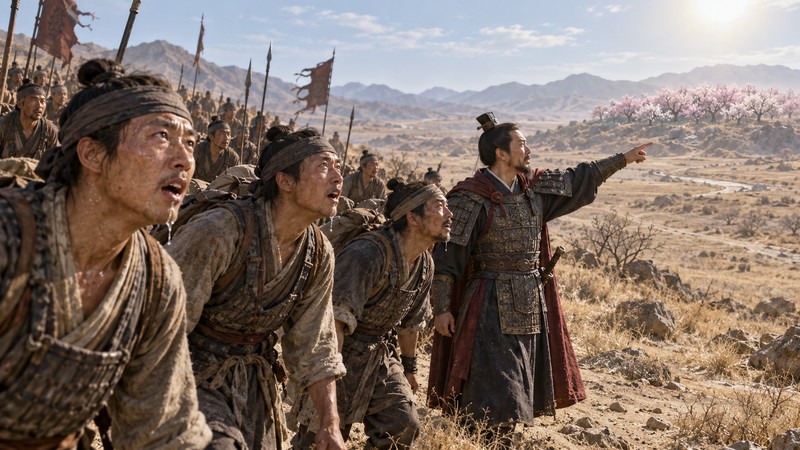
In Shishuo Xinyu (世说新语), the section Jia Jue (假谲) tells of Cao Cao leading soldiers who cannot find water. He says that a grove ahead has plentiful sweet-and-sour plums. Hearing this, the soldiers salivate and continue until they reach a water source. The passage presents an encouraging description, not soldiers actually eating plums.
The Ministry of Education’s idiom dictionary reproduces the original passage, including 士卒聞之,口皆出水,乘此得及前源。
This is a literary anecdote; it is not independent verification of a particular military event. The later idiom emphasizes imaginary consolation, not a method for replacing drinking water.
Pinyin and character notes
Read the four syllables as wàng méi zhǐ kě: fourth, second, third, and third tones. 望 means to look toward or hope for; 梅 refers here to plum fruit; 止 means to stop; 渴 means thirsty. Do not replace 渴 with 喝, which means to drink.
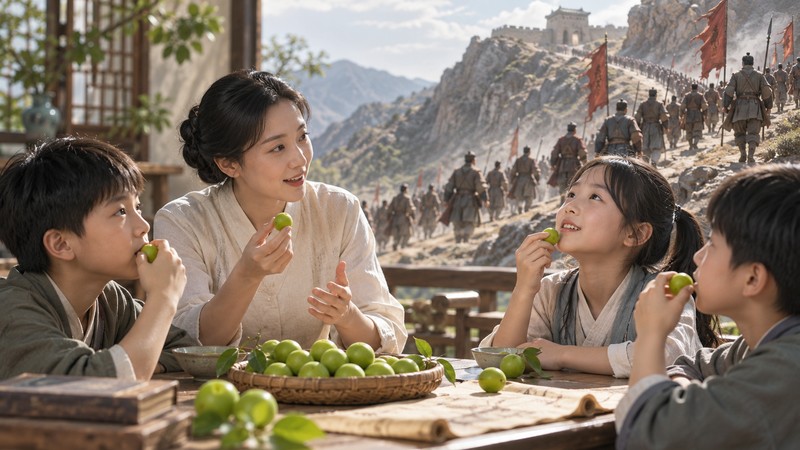
A classroom explanation can start with the sour taste of a plum, then distinguish imagining that taste from obtaining the thing one needs. The scene below illustrates a lesson; it does not document the ancient event.
Modern examples and the limit of the comparison
今年没时间去海边,只能看看照片,望梅止渴了。
Meaning: I have no time to visit the seaside this year, so I can only look at photographs for a little consolation. The photographs do not become an actual holiday.
只说以后会加薪,却一直没有兑现,不过是让大家望梅止渴。
Meaning: Repeated promises of a future pay rise, without delivering it, offer only imaginary satisfaction. This example has a critical tone; it does not praise practical planning.
By contrast, providing actual drinks or food meets an immediate need. Encouragement alongside real supplies is not, by itself, 望梅止渴.
Quick reference
The key distinction is imagined satisfaction versus actual fulfillment. For more examples of how a story becomes a four-character expression, see Chinese idioms in English and Chinese idioms for kids.
Frequently Asked Questions
Does Wang Mei Zhi Ke mean unnecessary worry?
No. It means comforting yourself with imagined satisfaction. Unnecessary worry belongs to a different idiom, Qi Ren You Tian (杞人忧天).
Did the soldiers eat the plums in the source passage?
No. The passage says they heard the description, salivated, and continued until they reached a water source.
Illustrations are explanatory scenes, not historical photographs or records of the original event.